

What are Air-Supported Buildings?
With a global market growth rate of more than 15% per year, air-supported structures—a major advancement in contemporary building technology—are revolutionizing our knowledge of architectural forms and functions. These constructions use air pressure difference as its main load-bearing mechanism, in contrast to standard buildings. High-strength membrane materials are “suspended” in the air by a continuous internal positive pressure system, resulting in entirely column-free, continuous areas.
The most recent study from the International Association for Shell and Spatial Structures (IASS) indicates that contemporary air-supported structures can reach spans of more than 200 meters at a cost per unit area that is only 30% to 50% that of conventional steel structures.
I. What are the Engineering Principles of air Supported Membrane Structures?
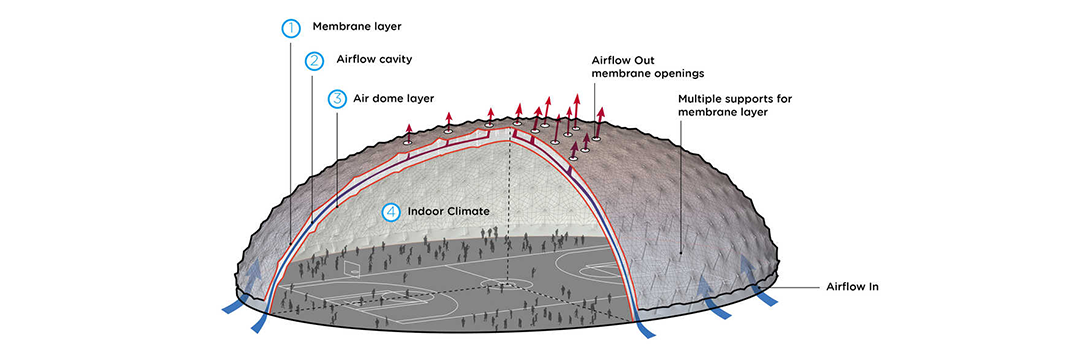
The engineering secret of air-supported buildings is built upon a precise system of physical balance, with its core principles divided into three interrelated technical dimensions:
Dynamic Control System of Air Pressure Balance
Intelligent gradient pressure control technology is used in contemporary air-supported constructions. The internal air pressure is accurately controlled within a range of 200–800 Pa greater than the external environment (corresponding to 0.2%–0.8% of ordinary atmospheric pressure) using a redundancy system made up of many variable-frequency blowers. The dynamic stabilization of this pressure differential is achieved by:
- Real-time Sensor Network: Ten times per second, pressure changes are tracked by pressure sensors placed inside the building.
- Adaptive Fan Regulation: The intelligent control system automatically increases fan speed when it detects a drop in pressure, and it boosts internal pressure to combat wind loads when it detects a rise in external wind force.
- Emergency Backup Systems: To ensure pressure stability in any emergency, all important facilities are outfitted with multiple or even triple backup power and fan systems.
Membrane Material Structural Mechanics System
The membrane material of an air-supported structure is not merely a covering but a “tensioned skin” that performs a structural function. The working principles of this system include:
- Prestress Distribution Mechanism: During installation, the membrane material is put under the proper amount of prestress. This prestress becomes uniform surface tension when it is subjected to internal air pressure.
- Doubly Curved Surface Form Optimization: The membrane material is placed in a state of pure tension under air pressure by the doubly curved surface shape created by computer simulation, making full use of the material’s tensile performance.
- Load Transfer Path: When external loads, like wind or snow, act on the membrane’s surface, the loads are transported to the ground foundation and anchoring boundaries via the tension of the membrane.
Anchoring and Boundary System
The anchoring system is ultimately responsible for the stability of the structure, and contemporary technology provides a number of methods for this:
- Continuous Concrete Beam Anchorage: The most robust connection, ideal for long-term projects.
- Helical Earth Anchor System: This system is quick to install and reusable, making it ideal for temporary or seasonal structures.
- Gravity Ballast System: Suitable for locations where ground penetration is prohibited, this system uses heavy materials to weigh down the membrane edges along the structure’s perimeter.
Air-supported structures can survive typhoon-force winds and snow loads of 100 kg per square meter while maintaining a very stable internal environment thanks to this multi-system engineering philosophy.
II. Why is Air-Supported Dome Becoming a Popular Choice?
The popularity of air-supported structures stems from their multiple advantages in economy, functionality, and sustainability, advantages validated by thousands of successful global cases:
Significant Economic Advantages
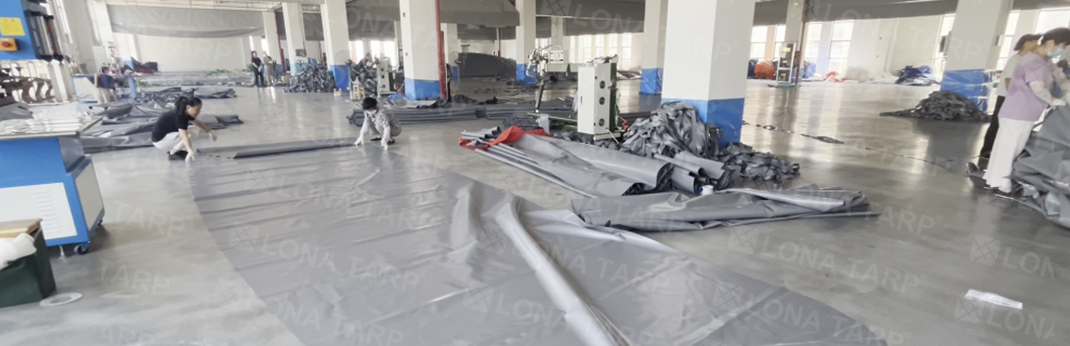
- Construction Cost Savings:Air-supported buildings can reduce their initial expenditure by 40% to 60% when compared to conventional steel structures. For instance, the air-supported system only costs 12–18 million RMB, but a 10,000-square-meter sports facility with a standard steel structure costs over 30 million RMB.
- Reduced Construction Timeline:It only takes one-third as long as traditional building to complete from concept. A typical air-supported structure takes 4–8 weeks to erect on site, while a traditional building of comparable size takes 6–12 months.
- Low Maintenance Costs: Annual maintenance costs are only 0.5%-1% of the construction cost, far lower than the 2%-3% for traditional buildings.
Excellent Functional Adaptability
- Optimal Space Utilization: Functional areas can be freely divided as needed thanks to the 100% column-free space design.
- Accurate Environmental Control: Internal temperature and humidity may be regulated within ±2°C and ±5% RH, respectively, thanks to the integration of clever environmental control technologies.
- Quick Functional Conversion: In only a few hours, the same area may be converted from a sports arena to an exposition center or performance space.
Sustainable Environmental Characteristics
- Material Recyclability Rate Up to 85%: The main material, PVC-coated polyester fabric, can be completely recycled and reused.
- Improved Energy Efficiency: Controllable light-transmissive membrane materials (5%-40% adjustable light transmittance) can reduce daytime lighting energy consumption by 70%.
- Reduced Carbon Footprint: The full lifecycle carbon emissions, from material production to building demolition, are reduced by over 60% compared to traditional buildings.
Because of these benefits, air-supported structures are not only the best option for sports facilities but are also becoming more and more popular in industries like logistics, manufacturing, and agriculture.
III. Diverse Applications of Air-Supported Buildings
Air-supported technology has broken through traditional boundaries and penetrated multiple layers of socio-economic life:
Sports And Leisure Sector
Over 5,000 air-supported sports facilities are in operation worldwide, with the most representative including:

- All-Weather Sports Venues: Montreal’s “Bubble Tennis Centre” in Canada consists of 12 connected air-supported domes, serving over 100,000 people annually.
- Aquatic Sports Centers: Dubai’s “Floating Air-Supported Pool” uses a double-layer membrane structure and operates stably at sea.
- Ice and Snow Sports Facilities: Several Nordic countries use air-supported structures to build movable ski training centers where internal temperatures can be maintained below -5°C long-term.
Industrial And Environmental Applications
- Environmental Enclosure Systems: Using 180,000 square meters of air-supported enclosure, a coal storage and transportation base in Shanxi, China, reduces dust emissions by 99.8%.
- Wastewater Treatment Covers: The Changi Water Reclamation Plant in Singapore efficiently controls the spread of odors by using air-supported covers for aeration tanks.
- Temporary Industrial Buildings: Production workshops and testing facilities for sectors including aerospace and automotive industry.
Agricultural And Special Applications
- High-Tech Agricultural Greenhouses: Desert agriculture projects in Israel use air-supported greenhouses, improving water efficiency by 70% and increasing yield threefold.
- Emergency Disaster Relief Facilities: Following the earthquake and tsunami in Japan, air-supported structures were erected within 24 hours to serve as temporary hospitals and shelters.
- Extreme Environment Workstations: Antarctic research stations use specially reinforced air-supported structures capable of withstanding temperatures as low as -60°C and winds of 40 meters per second.
IV. Choosing Professional-Grade PVC Fabric for Air-Supported Buildingss
The choice of membrane material must adhere to engineering-grade standards since it is the “life layer” of an air-supported structure. Haining Langlang offers the following expert material selection recommendations based on extensive project experience and technical expertise:

Mechanical Performance Index System
Our architectural membrane materials meet the following key indicators:
- Ultimate Tensile Strength: Warp direction ≥5000N/5cm, Weft direction ≥4500N/5cm (according to EN ISO 1421 standard)
- Tear Strength: ≥700N (according to EN ISO 4674 standard)
- Peel Strength: ≥80N/5cm (bond strength between coating and substrate)
- Dimensional Stability: Dimensional change rate ≤1.5% within temperature range -30°C to +70°C
Durability Certification System
All products pass rigorous testing:
- Weather Resistance Certification: Passes 500-hour QUV-B accelerated aging test, equivalent to 10-15 years of service life in natural environments.
- Chemical Resistance: Resists erosion from chemicals within pH range 3-11.
- Self-Cleaning Performance: PVDF surface treatment ensures surface cleanliness retention rate ≥85% within 5 years.
- Fire Rating: Meets EN13501-1 B-s1,d0 standard, Oxygen Index ≥32%.
Functional Customization Capabilities
We provide comprehensive customized solutions:
- Optical Performance Adjustment: Light transmittance adjustable from 5% to 40%, UV blocking rate up to 99%.
- Thermal Performance Optimization: K-value (thermal transmittance) as low as 1.2 W/m²·K.
- Acoustic Performance Enhancement: Sound absorption coefficient up to 0.7 at 500Hz frequency.
- Antimicrobial Treatment: Complies with ISO 22196 standard, antimicrobial rate ≥99%.
Project Support Services
In addition to products, we offer technical assistance.
- Structural Calculation Assistance: Provides membrane specification recommendations based on client design parameters.
- Processing Technical Support: Provides welding parameter guidance and seam design optimization.
- On-Site Installation Guidance: Dispatches technical personnel to assist with on-site technical issues.
- Maintenance Guide: Provides full lifecycle maintenance plans and spare parts support.
V. Conclusion
The building industry’s future lies in air-supported structures, which seamlessly combine structural engineering, materials science, and intelligent control to produce new, cost-effective, and ecologically friendly environments. Every construction of this kind that is effective depends on the dependable support of high-performance membrane materials.
Haining Langlang Coating Material Co., Ltd. has supplied more than one million square meters of expert membrane materials for air-supported structure projects in more than 20 countries globally by utilizing technological expertise in the field of PVC-coated fabrics and a comprehensive certification system. Our goods offer engineering solutions in addition to materials.
We provide full-process services, from material selection and performance verification to construction assistance, to project owners designing or building air-supported structures. For further technical details and project case references, please visit our official website at https://pvctarpaulin.com/ or our Alibaba International Station at https://lonatarpaulin.en.alibaba.com/. Let’s investigate the limitless potential of architectural space.
Share Thisw Story:
Table of Contents
Neena Zhou
Hello, I’m Neena, specializing in the PVC tarpaulin industry for over five years. Backed by our factory’s 20+ years of expertise and advanced coating technology production line , I am confident that our high-quality products and professional services will earn your trust. Feel free to contact us!
Try LonaTarp® Customize Your Tarpaulin Now
- PVC Formulation Properties
- Strength, Weight and Thickness
- Glossy, Matte, Color, Print and 3D Embossed Patterns
- Tarpaulin Roll Sizes and Packaging
- Cutting, Heat Sealing, Sewing, Add Eyelets, and Accessories Purchasing
