Production Process for PVC Knife-Coated Tarpaulin Fabric
Table of Contents
PVC Knife Coated Tarpaulin Fabric. This is a highly durable, waterproof, and tear-resistant tarpaulin fabric commonly used in demanding applications such as truck covers, large tents, inflatable products, awnings, water storage tanks, geomembranes, and more.
The core of its manufacturing process lies in the knife coating technique. Below are the typical production steps:
I. Raw Material Preparation
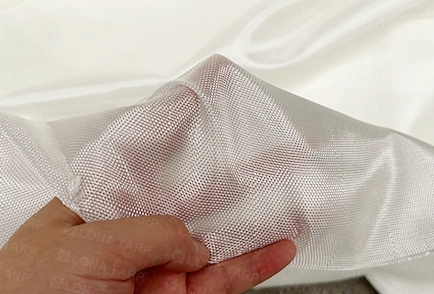
Base Fabric:Typically, high-strength woven polyester fabric is used as the substrate. This fabric needs excellent tensile strength, dimensional stability, and anti-creep properties. The base fabric may undergo pre-treatment (such as cleaning, heat setting) to ensure good coating adhesion and dimensional stability.
PVC Plastisol: This is the key coating material. Its main components include:
- PVC Resin Powder: Provides the primary physical and chemical properties.
- Plasticizers: Make PVC soft and elastic (e.g., DOP, DINP, DOTP).
- Stabilizers: Prevent PVC degradation due to heat and light during processing and use (e.g., calcium-zinc stabilizers, barium-zinc stabilizers).
- Fillers: Reduce cost and increase thickness and stiffness (e.g., calcium carbonate).
- Colorants/Pigments: Impart color to the product.
- Other Additives: Such as flame retardants, UV stabilizers, anti-fungal agents, lubricants, etc., added according to the final product’s performance requirements. These raw materials need to be thoroughly mixed uniformly in a high-shear mixer to form a plastisol with suitable viscosity.
II. Knife Coating
This is the namesake and most critical step of the process.
The prepared base fabric, under controlled tension, passes smoothly through the coating machine’s roller system.
The fabric first passes through a priming station (optional but common): A thin layer of PVC plastisol or adhesive is applied to enhance adhesion between the base fabric and subsequent thick coatings.
Then the fabric enters the main coating station(s):
- PVC plastisol is precisely applied (usually poured or spread) onto the fabric surface.
- A sharp, precisely adjustable knife blade rests tightly against the underside (or topside, depending on machine design) of the fabric. The fabric carrying an excess of plastisol passes under the blade.
- The knife blade precisely controls the amount of plastisol passing over the fabric, scraping off the excess, while leaving a very uniform, thickness-controlled PVC coating on the fabric surface. The blade profile, angle, distance from the fabric, and fabric running speed all directly affect coating thickness and uniformity.
This process usually requires multiple coating passes (e.g., 2-4 times or more) to achieve the final desired total thickness. After each pass, the coated fabric enters an oven for partial gelation (fusing) before the next coating pass.
III. Gelation and Fusion (Curing/Baking)
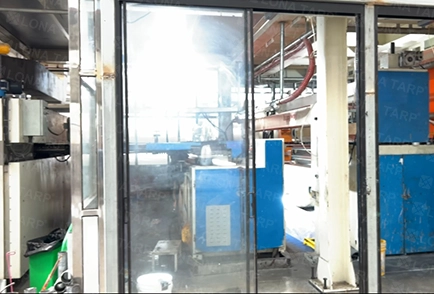
The coated wet film immediately enters a multi-section, long oven.
Under precisely controlled temperatures (typically in the range of 160°C – 220°C), the PVC plastisol undergoes physical and chemical changes:
- Gelation:Plasticizers penetrate the PVC particles, which begin to swell and bond together. The plastisol loses fluidity, forming an elastic gel with some strength.
- Fusion:At higher temperatures, the PVC particles completely melt, fully integrating with the plasticizers and other additives to form a continuous, uniform PVC plastic layer with its final physical properties. This process also ensures that various additives (e.g., stabilizers, UV inhibitors) function effectively.
Oven temperature and dwell time must be strictly controlled to ensure complete fusion without causing PVC degradation (yellowing/embrittlement).
IV. Cooling
The fully fused hot material immediately enters a cooling section, typically cooled rapidly by chilled rollers or cold air.
Cooling solidifies and sets the PVC layer, prevents blocking (sticking), and stabilizes the product’s dimensions.
V. Surface Treatment (Optional)
To achieve specific surface effects or functionality, the fused and cooled material may undergo additional treatments:
- Embossing:Passing through embossing rollers (hot or warm) to imprint patterns (e.g., diamond, plain), increasing surface friction, aesthetics, or hiding scratches.
- Glazing/Finishing:Applying a transparent layer of PVC or PU topcoat to improve surface gloss, stain resistance, and weather resistance.
- Laminating:Bonding a film or other material onto the PVC layer (less common, as knife coating itself allows for multi-layer application).
VI. Winding and Inspection
The waterproof knife coated PVC tarpaulin is wound into large rolls by an automatic winder.
Throughout the production process and before winding, there is online inspection (e.g., thickness gauges, pinhole detectors, visual inspection) and offline sampling. This strictly controls product quality: thickness uniformity, surface quality (free of bubbles, impurities, pinholes), peel strength, color, physical/mechanical properties (tensile strength, tear strength, low-temperature resistance, etc.), and weather resistance.
VII. Post-Processing
Large rolls of PVC knife coated tarpaulin fabric are shipped to downstream factories. They are cut, heat-sealed/welded, stitched, eyeleted, printed, etc., according to final product requirements to make various end products.
VIII. Key Advantages of the Knife Coating Process
- Ability to achieve thick coatings:Can produce very thick (typically thicker than calendering) and uniform coatings in one pass or through multiple passes.
- High Strength and Durability:The substantial PVC layer combined with the high-strength base fabric gives the product extremely high tear resistance, puncture resistance, abrasion resistance, and outstanding waterproofness.
- Excellent Dimensional Stability:Coating and baking under high tension make the product resistant to deformation.
- Good Surface Flatness:The knife blade produces a very smooth surface.
- Formula Flexibility:Easy to adjust the plastisol formulation to incorporate various functional additives (UV resistance, flame retardancy, etc.).
In summary, the production of waterproof knife coated PVC tarpaulin fabric is a technically demanding continuous process. Its core lies in precisely controlled knife coating and thorough fusion, ensuring the final product possesses exceptional physical properties and long service life.
Share Thisw Story:
Recent Articles
I am Linda Yu. I have been working in the PVC tarpaulin industry at Haining Lona Coated Material Co., Ltd. for nearly 10 years.With nearly 20 years of experience in the textile foreign trade industry. I am confident that my professional expertise and high-quality products will win your trust.