

Providing PVC Coating Materials for Global PVC Party Tent Brands
Table of Contents
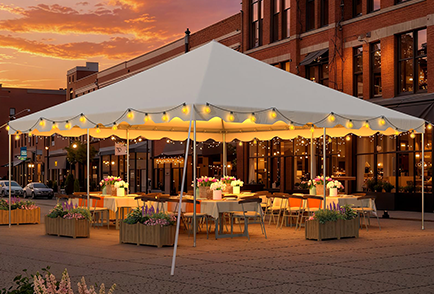
The fabric of your tent is its silent protector, according to manufacturers and brands in the international party tent market. Customers are drawn in by eye-catching patterns and vivid colors, but the PVC coating determines lifespan, performance, and safety of PVC party tent. A crucial business choice that affects your brand’s reputation, cost-effectiveness, and competitiveness in the market is selecting the appropriate PVC coating material. This comprehensive blog explores the key elements of high-performance PVC party tent, enabling you to choose your goods wisely.
I. Why is High Tear Strength and Durability Preferred for 20×40 PVC Party Tents?
Large-scale tents, particularly the standard 20×40 PVC party tents, operate under a completely different set of physical laws than their smaller counterparts. The preference for exceptional tear strength and durability is not arbitrary; it’s a direct response to the immense structural demands placed on these expansive shelters.
The “Sail Effect” and Structural Integrity
A 20×40 tent functions as a big sail, offering the wind a large surface area. The cloth is under extreme tensile stress during a rapid gale, tugging against every seam, grommet, and frame connection, rather than passively flapping. The capacity of a PVC party tent to prevent a little puncture (from a branch, a tool, or even a tension concentration) from spreading into a disastrous, tent-ending rupture is known as high tear strength. This is about preventing complete structural breakdown during an unforeseen storm, not simply about lifespan.
The Rigors of Commercial Use: Beyond the Weather
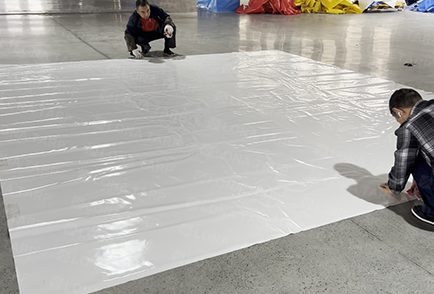
There is more to durability than just withstanding one storm. A 20*40 PVC party tent’s operating lifetime includes frequent assembly, disassembly, folding, transportation, and storage. Every cycle strains the material’s durability, causes abrasion, and stresses fold lines. Over hundreds of cycles, a 20*40 PVC party tent with excellent durability won’t thin, fracture, or fade, keeping 20*40 PVC party tent looking professional and preventing expensive, early replacements. Before its time is up, inferior cloth of PVC party tent will seem worn and unprofessional due to the rapid development of weak places.
The Critical Role of Seam and Stitch Integrity
The needle holes created during stitching are the natural weakest points in any fabric panel. High-quality, durable PVC celebration tent helps to “lock” the threads in place and reinforces the material around these holes. This prevents the fabric from tearing away from the stitches under load, a common failure point in poorly constructed tents. In essence, the coating works synergistically with the sewing process to create a unified, robust 20*40 PVC party tent.
II. Custom Solutions for Fire-Retardant, Cold-Resistant (-30°C) Party Tent Fabrics
The one-size-fits-all approach is a recipe for failure in the global market. Party tent fabric designed for a desert festival will face vastly different challenges than one destined for a winter event in the mountains. Custom-engineered party tent fabrics are essential for meeting these diverse and extreme requirements.
The Science of Modern Fire Retardancy (FR)

Rather than being applied topically, true fire retardancy is built into the coating. During the formulation process, advanced FR compounds are directly incorporated into the PVC plastisol. These additives function in two main ways when exposed to flame: they release non-combustible gases that dilute oxygen at the flame front and produce an insulating, carbonaceous “char” layer that protects the underlying fabric. In addition to fulfilling strict international safety standards like NFPA-701, this dual-action technique successfully self-extinguishes the material, giving occupants who live in PVC paty tent crucial extra minutes for evacuation.
The Efficiency of Quality: A Manufacturing Perspective
Standard PVC party tent fabric becomes brittle, inflexible, and prone to cracking at temperatures as low as -30°C—imagine trying to bend a plastic ruler in freezing weather. As a result, the tent is unreliable and setup is risky. Specialized low-temperature plasticizers are the answer. These sophisticated plasticizers are made to stay stable and embedded in the PVC party tent fabrics, in contrast to their conventional equivalents, which can migrate to the surface or volatilize. Even in extremely cold temperatures, party tent fabric preserve molecular mobility, guaranteeing the fabric’s pliability, strength, and safety during the most severe winter weather.
Achieving Balanced Performance
The ultimate challenge is creating a party tent fabric that doesn’t sacrifice one property for another. A PVC coating cannot be optimized for cold resistance at the expense of its fire retardancy, or vice versa. This requires sophisticated formulation and rigorous testing to ensure that all required properties—FR, cold resistance, UV stability, and tensile strength—are delivered in a single, high-performance material.
III. How to Reduce the Total Cost of Ownership for B2B Tent Fabric Procurement
Smart procurement in the B2B space is about looking beyond the initial price per square meter. The most impactful metric for your bottom line is the Total Cost of Ownership (TCO), which encompasses all costs associated with the tent fabric throughout its entire service life.
The True Cost of “Cheap” Fabric
A lower upfront cost can be deceivingly expensive. Consider the hidden costs of inferior tent fabric:
- Warranty and Replacement: Tent fabric that fails prematurely leads to warranty claims, free replacements, and the logistics costs associated with them.
- Production Downtime: Inconsistent or poor-quality tent fabric causes jams in automated cutting and welding machines, leading to production delays and wasted labor.
- Brand Damage: The long-term cost of customer dissatisfaction and a tarnished brand reputation due to product failure is immeasurable but devastating.
The Efficiency of Quality: A Manufacturing Perspective

High-quality, consistent tent fabric is a dream to work with on the production floor. It feeds smoothly, welds perfectly, and cuts cleanly. This manufacturing efficiency reduces waste, minimizes rejects, and optimizes labor hours. The savings gained here often far outweigh the minor initial savings from a cheaper, problematic tent material.
Strategic Sourcing and Partnership
Reducing TCO isn’t just about the tent fabric itself; it’s about the supplier relationship. A reliable partner acts as an extension of your team, offering:
- Technical Support: Assisting with specification optimization to avoid over-engineering or under-specifying.
- Supply Chain Reliability: Ensuring on-time delivery to prevent production stoppages.
- Inventory Management: Some suppliers offer programs that can help you reduce your own inventory carrying costs.
IV. What is the Best Material for a PVC Canopy?
The search for the “best” PVC canopy material is a search for the optimal balance of performance, durability, workability, and cost for a given application. For the vast majority of commercial party tent applications, the evidence points to one clear winner.
PVC-Coated Polyester: The Industry Workhorse for a Reason
The perfect balance is achieved with polyester cloth coated with PVC. A strong skeleton is formed by the high-tenacity polyester scrim, which offers remarkable tensile and tear strength. This scrim’s PVC coating, which is laminated onto it, offers a 100% waterproof barrier, superior UV resistance, and a surface that may be customized in terms of color and quality. Because of its adaptability, producers can customize the fabric with particular additions for FR, cold resistance, or antimicrobial qualities. PVC canopy is also very weldable, making it possible to create sturdy, long-lasting, and waterproof seams.
A Comparative Look at Alternatives
- Polyethylene (PE) Tarps: While low-cost, PE is a short-term solution. It lacks the tear strength, UV stability, and overall durability for professional, reusable tents. It degrades quickly and becomes brittle.
- Vinyl-Laminated Polyester: A high-end option with exceptional durability and longevity, often used in permanent tension structures. However, its significantly higher cost and heavier weight make it less practical for the portable party tent market.
- Advanced Composites: New materials with hierarchical structures or nano-treated coatings are emerging, offering exciting potential for niche applications, but they are not yet cost-effective for mainstream party tent use.
V. Conclusion: An Investment in Your Product’s Foundation
Choosing the proper PVC party material is a critical investment in the longevity and quality of your party tents. You can build PVC party tents that withstand time and weather by prioritizing engineered durability for large-scale structures, embracing custom solutions for extreme environments, adopting a TCO mindset for smarter procurement, and relying on the proven performance of PVC-coated polyester.
Share Thisw Story:

I am Suki. I’m working in the PVC tarpaulin industry at Haining LonaCoated Material Co., Ltd . Applying my PVC tarpaulin expertise, I deliver tailored solutions to meet your exact requirements, ensuring smooth project delivery through reliable products and dedicated support.