

Tensile Canopy Structure for Modern Outdoor Spaces
The tensile canopy structure has become a key architectural feature in the design of contemporary outdoor spaces. These lightweight, graceful forms are changing how we perceive public and commercial places, from the sweeping roof of a stadium grandstand to the welcoming entrance of a city hotel. A tensile canopy structure produces vast, clear spans with a visual lightness that is unmatched by traditional construction by combining high-strength materials with effective engineering.
Understanding these systems’ fundamental ideas, available materials, and design options is crucial as architects and designers specify them more and more. Everything you need to know about the tensile canopy structure is covered in this tutorial, from its fundamental mechanics to how important it is to choose a supplier of high-quality tensile fabric. With more than ten years of production experience, Haining Lona Coated Material Co., Ltd. offers certified PVC solutions for project-specific requirements.
I.What Is a Fabric Canopy Roof and How Does It Work
Tensioned membrane material serves as the main structural and weatherproofing layer of a fabric canopy roof, a long-span, lightweight roofing design. A fabric canopy roof gets its strength and stability from pre-tension applied to a flexible fabric membrane, in contrast to traditional roofs that rely on heavy decking and beams.
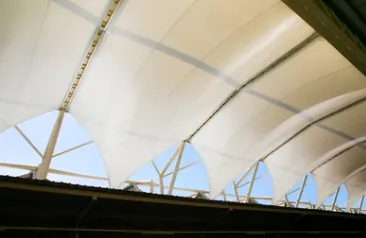
The Principle of Pre-Tension
The fundamental functioning principle is straightforward but efficient. The membrane is stretched taut over a supporting framework of steel cables, masts, or trusses. The membrane is usually a high-strength woven polyester fabric coated with PVC. The fabric develops a balanced stress field as a result of this pre-tension. Once tensioned, the membrane retains its elegant, curved shape while being stiff enough to withstand external loads like wind uplift, rain, and snow accumulation.
How It Supports Loads
The forces exerted by wind or snow on a fabric canopy roof are transmitted through the membrane as in-plane tension. The fabric can effectively redistribute these stresses to the boundary support system because of its curved shape, which is frequently created as a “double-curved” or “anticlastic” surface (like a saddle). As a result, the structure is surprisingly light and incredibly sturdy, usually weighing only 1/30th that of a traditional steel roof.
Key Components
A complete fabric canopy system comprises:
- The Membrane: The PVC-coated polyester fabric, which acts as both structure and cover.
- The Support Structure: Steel cables, columns, or frames that provide the boundary tension.
- The Anchoring System: Foundations and connections that safely transfer all forces to the ground.
Understanding this mechanism is the first step in appreciating why the fabric canopy roof has become a preferred solution for airports, sports venues, commercial plazas, and hospitality spaces worldwide.
II.Design Options for Tensile Structure Canopy Systems
The versatility of the tensile structure canopy lies in its nearly limitless design possibilities. Advances in computational design and material technology allow for custom shapes, sizes, and aesthetic finishes.
Form and Geometry
Modern tensile structure canopy designs can be broadly categorized by their geometric form:
● Conical (Cone) Shapes: Ideal for point-supported canopies, creating a dramatic focal point.
● Barrel Vaults: Cylindrical forms suitable for linear coverings like walkways or platforms.
● Hypar (Hyperbolic Paraboloid) Shapes: The traditional saddle form works well for covering wide, uneven areas with little assistance.
● Custom Free-Form: Computer-aided design enables the creation of distinctive, organic shapes that are suited to certain architectural visions.
Functional Customization
Performance is customized by material choice in addition to shape:
● Optical Performance: Membranes can be either completely opaque (≥99% blackout) or translucent (4–15% light transmission) , which eliminates the need for artificial lighting.
● Color and Finish: A variety of colors are offered, as well as finishes including glossy, matte, or printed with unique logos utilizing cutting-edge printing technology.
● Integrated Features: PVDF-coated surfaces for improved self-cleaning, integrated drainage, and lighting fixtures can all be incorporated into canopies.
Structural Configurations
The supporting framework can be designed to suit the site:
● Cable-Supported: Minimalist steel cable networks for a “floating” appearance.
● Mast-Supported: Central or offset masts create dramatic, high-point entrances.
● Frame-Supported: Rigid steel trusses or arches for defined perimeters and high load capacities.
This design flexibility makes the tensile structure canopy adaptable to almost any architectural requirement, from a small, intimate garden shelter to a massive, iconic transportation hub.
III.PVC Fabric Materials Used in Canopy Structures
Any durable canopy is built on the membrane itself. PVC-coated polyester fabric is the most often specified material for commercial and public tensile structure canopy projects due to its remarkable combination of performance, longevity, and value.
Base Fabric and Coating
A high-tenacity polyester foundation fabric, frequently made with 1000D yarns or higher with dense weaves (e.g., 20×20), is the starting point for high-quality PVC fabric. The basic tensile and tear strength needed for lengthy spans is provided by this substrate. PVC resin is then applied to this woven basis, giving the fabric its key characteristics:
● Complete Waterproofing
● UV Resistance & Stability: After three to five years of outdoor exposure, the fabric retains more than 70% of its strength thanks to UV stabilizers.
● Fire Retardancy: Formulations that meet international standards, such as NFPA 701 or EN 13501-1 B-s1,d0, are essential for public safety.
● Dimensional Stability: Does not significantly distort when exposed to temperature extremes between -30°C and +70°C.
Advanced Surface Treatments
To extend service life and reduce maintenance, top-quality PVC fabrics receive additional surface coatings:
- PVDF (Polyvinylidene Fluoride) Lacquer: This top layer provides superior dirt-shedding self-cleaning properties, ensuring the canopy remains visually striking with minimal washing. It also significantly enhances resistance to UV degradation and chemical attack.
- Acrylic Topcoats: Offer good UV protection and color retention at a more economical price point.
Certifications and Performance
For critical projects, material verification is essential. Haining Lona provides PVC fabrics tested to rigorous standards, offering third-party reports for:
- Tear Resistance (e.g., ASTM D751)
- Abrasion Resistance (Taber test)
- Anti-Mildew Properties (ISO 846, ASTM G21)
- Environmental Compliance (REACH, RoHS)
Choosing the right PVC fabric grade—with the appropriate weight (gsm), weave density, and coating formulation—is the most critical decision affecting the canopy’s lifespan, safety, and aesthetic durability.
Why Partner with Haining Lona?
Haining Lona Coating Materials Co., Ltd. is dedicated to provide engineering solutions rather than just standard materials as a professional supplier of tensile membrane materials. Our dedication to timely delivery and quality is demonstrated by the complete traceability of our products and their stellar supplier rating. With materials that give decades of strength, durability, and aesthetics, we assist architects and builders in realizing their ideas for tensile membrane structure roofs.
IV.Design Options for Fabric Canopy Structures
One of the biggest advantages of tensile fabric structures is their design flexibility. Architects can create a wide range of shapes and forms depending on the project requirements.
Some common fabric canopy designs include:
Hypar (Hyperbolic Paraboloid) Structures
These structures feature a twisted surface created by opposing high and low points. They are visually dramatic and structurally efficient, often used for playground or plaza shading.
Conical Canopies
Conical structures use a central high point with fabric sloping downward toward the perimeter. They are frequently used in parking areas, outdoor dining spaces, and entrance plazas.
Barrel Vault Designs
A barrel vault canopy forms a curved arch-like shape. This design is commonly used in walkways or corridors where continuous coverage is needed.
Multi-panel Shade Systems
Large spaces can be covered by combining multiple fabric panels connected through a shared structural frame. This approach is common in stadiums, transport terminals, and event venues.
In addition to structural form, fabric canopy systems also offer flexibility in color, translucency, and surface treatments. For example, PVC-coated fabrics can be produced with UV protection, waterproof coatings, flame-retardant properties, and anti-mildew treatments, making them suitable for long-term outdoor applications.
V.Conclusion
The tensile canopy structure offers contemporary outdoor areas a special blend of high performance and aesthetic elegance. It is a clever blend of engineering and art. You can produce historic projects that endure by comprehending the workings of the fabric canopy roof, investigating the wide range of design alternatives for tensile structure canopy systems, and choosing high-quality PVC fabric materials.
The choice of partner and material is a crucial element that connects excellent design with sustained success. The proven quality, technological know-how, and customisation options that transform architectural concept into built reality are provided by a reputable tensile fabric supplier.
For your upcoming projects, consider materials engineered for performance and backed by proven industrial capability. Visit Haining Lona Coated Material Co., Ltd. online or explore our product range on our Alibaba store to discuss how our PVC fabric solutions can support your next tensile canopy structure.
Share Thisw Story:
Table of Contents
Neena Zhou
Hello, I’m Neena, specializing in the PVC tarpaulin industry for over five years. Backed by our factory’s 20+ years of expertise and advanced coating technology production line , I am confident that our high-quality products and professional services will earn your trust. Feel free to contact us!
Try LonaTarp® Customize Your Tarpaulin Now
- PVC Formulation Properties
- Strength, Weight and Thickness
- Glossy, Matte, Color, Print and 3D Embossed Patterns
- Tarpaulin Roll Sizes and Packaging
- Cutting, Heat Sealing, Sewing, Add Eyelets, and Accessories Purchasing
