

What is the Difference Between Air Inflated and Air-Supported Structures?
I. What Are Air-Inflated Structures and Air-Supported Structures?
From an engineering perspective, air-inflated structures are defined as buildings in which the structural elements themselves are inflated. Their load-bearing capacity does not depend on the air pressure inside the enclosed space, but rather on the air sealed within specific structural components. Once these components are inflated, they gain sufficient stiffness to withstand wind loads, snow loads, and certain external forces. Because the structural function is distributed among multiple independent units, air-inflated structures are typically designed with multi-chamber or modular systems to reduce the risk of total failure caused by localized damage.
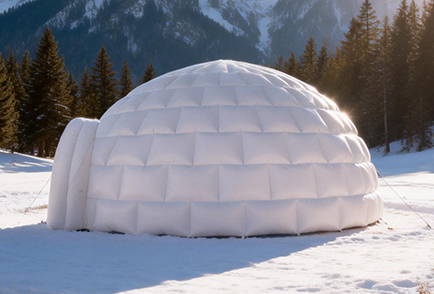
In practical applications, air-inflated structures demonstrate strong adaptability. They can be installed and dismantled in a short time and usually require minimal foundation work, making them ideal for temporary projects or sites with limited ground conditions. Even when active air supply is stopped, the structure does not collapse immediately, a feature that is particularly valuable in emergency situations or regions with unstable power supply.
Air-supported structures, by contrast, are based on a completely different structural concept. Instead of relying on inflated beams or columns, the entire enclosed space is continuously pressurized so that the internal air pressure remains slightly higher than the external environment. This stable pressure differential lifts and supports the membrane roof as a whole. In this system, ventilation equipment, airtightness control, and the overall performance of the membrane material are far more critical than the strength of any single component.
This design approach allows air-supported structures to achieve exceptional span capacity and spatial integrity, but it also means that their operational stability is highly dependent on continuous energy supply.
II. What Are the Advantages of Air-Inflated Structures and Air-Supported Structures?
The advantages of air-inflated structures lie primarily in flexibility and safety redundancy. Because the load-bearing logic is distributed across multiple independent units, these structures are less dependent on continuous air supply and are generally easier to manage during operation. Even if localized damage occurs, the structure can usually maintain its basic shape, allowing sufficient time for inspection and repair. This characteristic is particularly important for high-frequency use or applications requiring rapid response.
In addition, air-inflated structures offer greater freedom in architectural form. By adjusting the size, arrangement, and connection of inflated components, designers can create a wide range of spatial shapes. This makes them especially attractive for exhibitions, promotional events, and commercial installations where visual impact and brand recognition are important.
The advantages of air-supported structures are more closely related to scale efficiency and space utilization. When a project requires a large, unobstructed interior area, air-supported structures are often the most practical solution. Whether for sports training facilities, industrial warehouses, or temporary production halls, these structures can provide vast, column-free spaces without internal supports. This significantly improves functional efficiency and allows greater flexibility for future layout changes.
Moreover, air-supported structures benefit from relatively uniform load distribution. Under internal pressure, the membrane forms a continuous curved surface, which helps disperse external loads and reduce the risk of localized stress concentration.
III. Cost Differences Between Air-Inflated Structures and Air-Supported Structures
In real projects, cost is often a decisive factor, but the comparison is far more complex than simply identifying which option is cheaper. Air-inflated structures typically require higher-grade materials and more precise manufacturing processes, particularly in welding strength, airtightness control, and structural connections. These requirements result in higher initial production costs.
From an operational standpoint, however, air-inflated structures usually consume less energy. Since they do not require constant pressurization of the interior space, long-term operating expenses are easier to predict and control. For projects with limited service life or high sensitivity to energy costs, this cost structure can be especially advantageous.
Air-supported structures often have a lower initial investment, particularly when covering large areas, as the cost per square meter decreases significantly with scale. However, this advantage comes with ongoing operational expenses. Continuous operation of blowers, electricity consumption, emergency backup systems, and routine maintenance generate costs throughout the structure’s lifecycle. If these factors are not fully considered during the planning phase, long-term operational pressure may exceed expectations.
IV. Taking Air-Supported Domes as an Example
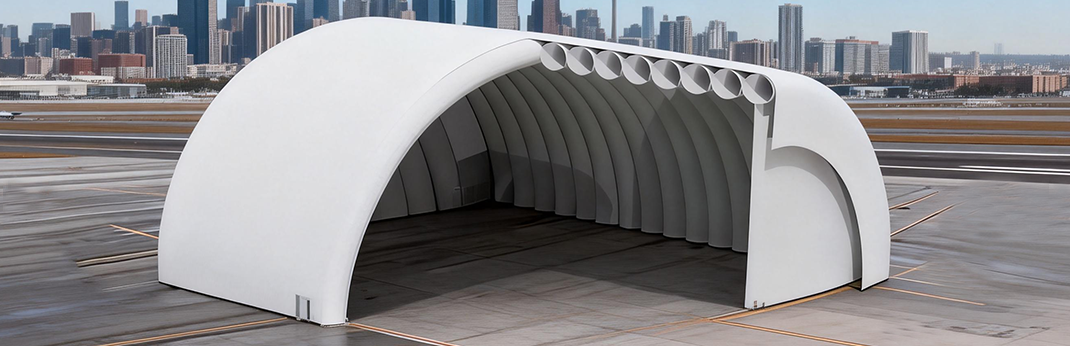
In air-supported dome structures, PVC tarpaulin or composite membrane materials are not merely used as a protective covering; they form an integral part of the structural system and directly influence the long-term operational stability of the entire building. Compared with conventional tents or standard inflatable structures, air-supported domes impose more implicit yet significantly stricter performance requirements on membrane materials. These requirements are not always clearly stated in design drawings or procurement specifications, but they become increasingly evident over extended periods of operation.
First and foremost, the long-term mechanical stability of the material under continuous tensile stress must be carefully considered. In an air-supported dome, the membrane remains in a constant state of tension throughout its service life, rather than being subjected to short-term or intermittent loads. Consequently, the material must not only meet the required tensile strength during initial testing but also retain sufficient safety margins after years of sustained loading. If long-term creep or irreversible elongation occurs, the geometry of the dome may gradually change, even when internal air pressure remains within the designed range, ultimately affecting both structural stability and visual integrity.
At the same time, air tightness takes on an amplified importance in air-supported dome applications. Even minor air leakage can lead to increased operating time of the blower system, higher energy consumption, and accelerated wear of mechanical equipment. Over the long term, insufficient air tightness not only raises operational costs but also places additional stress on the ventilation system. For this reason, factors such as coating uniformity, weld quality, and stable adhesion between the coating and the base fabric are often more critical than simply increasing material thickness or weight.
Weather resistance is another essential factor that cannot be overlooked. Air-supported domes typically present large surface areas that remain continuously exposed to outdoor environments. Ultraviolet radiation, temperature fluctuations, humidity, and wind-driven particles act persistently on the membrane material. If the PVC tarpaulin has inadequate resistance to UV exposure or long-term aging, degradation of mechanical properties may occur gradually and remain unnoticed until structural safety margins are significantly reduced. This type of delayed failure is particularly critical in air-supported structural systems.
Fire performance also plays a vital role in air-supported domes, extending beyond basic regulatory compliance. Because the structural integrity of the dome depends on internal air pressure, the fire behavior of the membrane material directly affects evacuation conditions and overall structural response during emergencies. PVC membranes with appropriate flame-retardant properties can slow flame spread and provide valuable time for evacuation and intervention, which is why air-supported domes used for sports facilities and public spaces are typically required to meet strict fire safety standards.
From a manufacturing perspective, air-supported domes demand a high level of material consistency. Variations in performance between different production batches, which may be acceptable in simpler applications, can result in localized stress differences within an air-supported dome, increasing the complexity of structural adjustment and long-term maintenance. Therefore, a stable raw material system, mature coating processes, and rigorous quality control are fundamental yet often overlooked factors that underpin the successful performance of air-supported dome projects.
In summary, air-supported domes are not structures in which membrane materials can be selected or replaced arbitrarily. Their long-term safe and stable operation depends on a balanced combination of mechanical strength, air tightness, weather resistance, and fire performance. For project owners and designers, understanding these implicit requirements enables more informed decisions during the early stages of planning. For experienced PVC tarpaulin manufacturers, these requirements represent a clear reflection of technical capability and a deep understanding of structural applications.
V. How to Evaluate Whether an Air-Supported Structure Is Worth It
The decision to adopt an air-supported structure should be based on the overall operational logic of the project. If stable energy supply is available and long-term demand for large, unobstructed space is clear, air-supported structures often offer strong advantages in terms of overall cost efficiency and functionality. Conversely, if the project duration is uncertain or rapid installation and dismantling are critical, air-inflated structures may be the more practical choice.
Management and maintenance capability should also be carefully evaluated. Air-supported structures require continuous monitoring of internal pressure, equipment performance, and membrane condition, which places higher demands on the professionalism of the operating team.
VI. How to Choose the Right Structural Type and Materials
In the final decision-making stage, structural selection should be closely integrated with material performance evaluation. Whether air-inflated or air-supported, the physical properties and durability of the core materials directly determine the safety margin and service life of the structure. For PVC-coated fabrics and composite membranes, tensile strength, tear resistance, UV resistance, and fire performance are all critical indicators for long-term applications.
In practice, experienced project owners rarely evaluate “structure type” or “material price” in isolation. Instead, they consider the structural system and material performance as a whole, aiming to achieve an optimal balance between safety, economy, and sustainability.
VII. Conclusion
Share Thisw Story:
Table of Contents

Felicia Qi
I am Felicia. I have been working in the PVC tarpaulin industry at Haining Lona Coated Material Co., Ltd. for nearly 10 years.With nearly 20 years of experience in the textile foreign trade industry. I am confident that my professional expertise and high-quality products will win your trust.
Try LonaTarp® Customize Your Tarpaulin Now
- PVC Formulation Properties
- Strength, Weight and Thickness
- Glossy, Matte, Color, Print and 3D Embossed Patterns
- Tarpaulin Roll Sizes and Packaging
- Cutting, Heat Sealing, Sewing, Add Eyelets, and Accessories Purchasing
