

Air Inflated Buildings vs Inflatable Dome Building vs Pneumatic Structure Building
Inflatable buildings, aerodynamic structures, and inflatable domes are moving from concept to widespread application at an unprecedented pace, providing efficient, adaptable, and sustainable building solutions for sports facilities, industrial warehousing, or temporary events.
As Haining Lona Coated Material Co., Ltd., we have extensive knowledge of the varying material performance needs for different pneumatic constructions due to our significant expertise in coated textiles such as PVC tarpaulin and scrim-reinforced mesh fabric. Inflatable buildings, inflatable domes, and pneumatic structures are three popular but frequently misunderstood forms that will be thoroughly explained in this article along with an analysis of their design principles and application differences. The essay will conclude with advice on how to choose the best fabric option for your project.
I. What Are Air Inflated Buildings and Pneumatic Structure Buildings?
First, we must define two key terms: pneumatic structures and inflatable buildings. Although they both use air as a support medium, their underlying ideas and levels of application differ greatly.
Generally speaking, inflatable buildings are those that get their shape and stability from positive-pressure air inside one or more sealed air chambers. They resemble enormous, air-filled “pillows” or “mattresses.” In order to maintain interior air pressure, which is normally just 250–1000 Pascals above exterior pressure, these buildings rely solely on continuous fan systems; if pressure is lost, the structure collapses. As a result, they work better in situations requiring short-term, movable, or temporary use, including bounce houses, makeshift warehouses, and shelters for disaster aid.
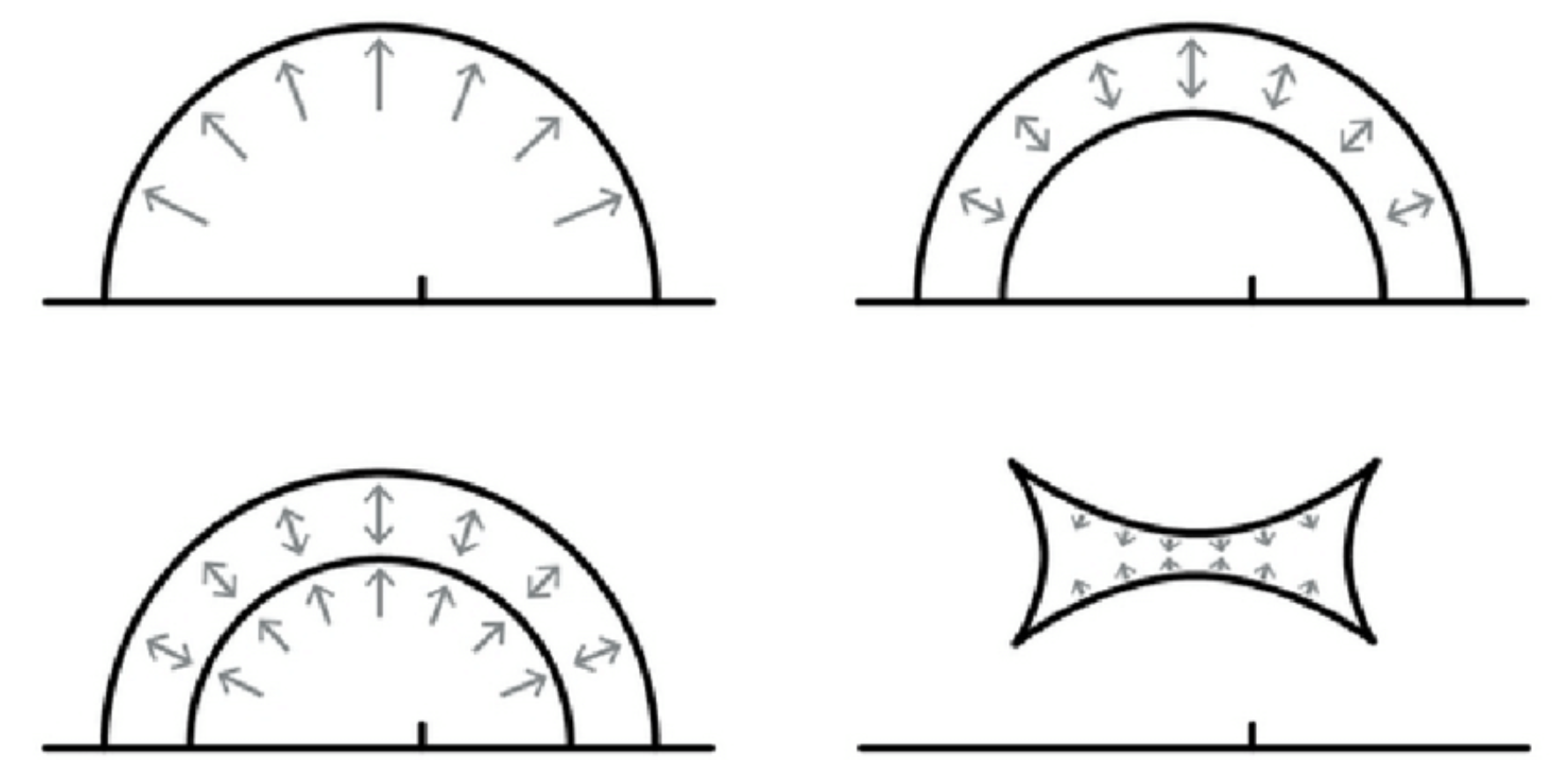
In architecture, pneumatic structure buildings are a more expansive and expert category. It particularly refers to buildings, whether permanent or semi-permanent, that use air pressure difference as their main structural load-bearing mechanism. This includes both the aforementioned inflatable type and more intricate systems, like:
- Air-Supported Structures: This is the technical term for what we commonly call an “inflatable dome.” It works by pressurizing the entire enclosed space defined by a single-layer membrane, tensioning and stabilizing the membrane surface to create vast column-free spaces.
- Air-Inflated (or Air-Beam) Structures: The building consists of a series of parallel, independently pressurized, arched tubular air beams placed side-by-side, topped with a separate cover membrane. This structure offers higher stability; if one air beam fails, the entire structure does not immediately collapse.
- Hybrid Structures: These combine pneumatic principles with traditional rigid structures (like cables, trusses) to form more complex and stable systems.
In a nutshell, an inflatable building is a particular, streamlined version of a pneumatic construction. The more accurate name “Pneumatic Structure” refers to professional, large-span structures designed for long-term performance.
II.How Inflatable Dome Buildings Are Designed and Used
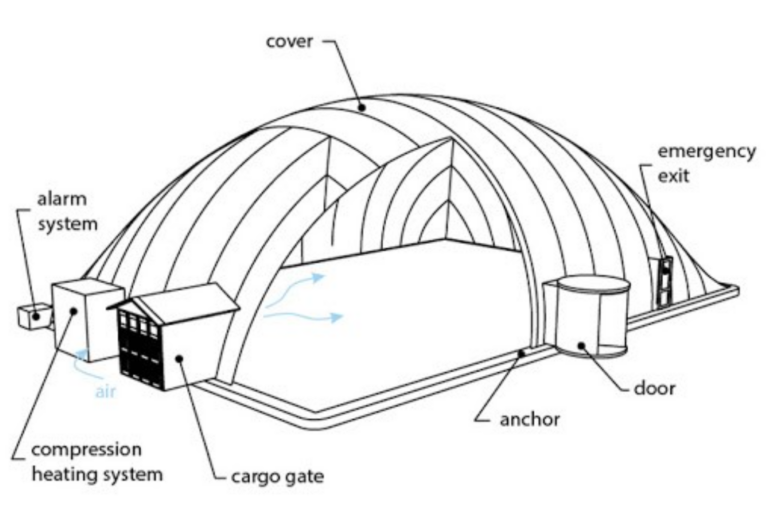
The Three Core Design Elements:
- The Membrane System (The Skin & Skeleton): This is the main factor influencing the building’s functionality, longevity, and security. For the membrane to endure internal pressure, wind, and snow loads, it needs a very high tensile and tear strength. It must also have outstanding airtightness, self-cleaning qualities, and weatherability (UV resistance, temperature tolerance). For example, our membranes successfully withstand UV deterioration because they employ a high-density polyester substrate with a PVDF top coating. Airtightness depends on the seam strength being close to that of the base material, which is ensured via high-frequency (HF) welding.
- The Mechanical System (The Heart & Nerves): This contains a sophisticated pressure sensor and control system and blower units (usually with one active, one standby, or possibly two active, one standby configuration). To ensure structural stability in all weather circumstances, the system must continuously monitor the internal-external pressure differential and automatically modify to account for variations in wind load and disruptions from entry/exit points.
- The Anchoring and Foundation System (The Footing): Depending on whether the building is temporary or permanent, methods like gravity ballast (concrete blocks), screw anchors, or permanent concrete foundations are used to securely fix the membrane edges, resisting the structure’s uplift force.
Typical Usage Workflow:
Using inflatable domes shows a great deal of adaptability. Compared to traditional construction, the full process can be completed in a matter of weeks, including membrane panel prefabrication at the factory, packing, and shipping, as well as on-site deployment, anchoring, and inflation for commissioning. It can establish a regulated, constant humidity and temperature inside as a sports arena. It allows for all-weather, enclosed operations as an environmental enclosure for industrial warehousing or coal storage, removing dust pollution. Membranes with adjustable light transmittance can offer ideal growing conditions in an agricultural greenhouse. The structure’s circular value can be realized by deflating, disassembling, and moving it for future usage after the project is over.
III.What are the differences between these building types?
To understand more intuitively, we can compare these three building types across multiple dimensions:
Dimension | Inflatable Building | Inflatable Dome (Air-Supported) | Air-Beam / Hybrid Pneumatic Structure |
Core Principle | Positive pressure in single-chamber air cells | Positive pressure in an overall enclosed space | Support from arrays of tubular air beams, or hybrid with cable nets |
Structural Form | Relatively simple shapes (arches, spheres) | Large, continuous double-curved dome | More diverse forms (linear, curved) |
Span Capability | Smaller, typically for small/medium temporary facilities | Very Large, easily achieves 100m+ column-free spans | Medium to Large, with superior stability |
Stability & Safety | Lower, relies on constant air supply, risk of cell puncture | High, with intelligent pressure control, but requires maintaining overall pressure | Highest, independent air beams, local failure doesn’t compromise whole |
Airtightness Requirement | High (individual air cell) | Extremely High (entire building envelope) | High (each air beam unit) |
Membrane Performance Req. | Focus on tear/abrasion resistance, basic weatherability | Most Comprehensive: High strength, high weatherability, high airtightness, self-cleaning | Focus on air beam material’s pressure fatigue resistance & seam strength |
Typical Applications | Inflatable toys, temporary shelters, inflatable boats | Sports stadiums, aquatic centers, large warehouses, wastewater tank covers | Swimming pools, exhibition halls, aircraft hangars, special facilities |
Cost & Timeline | Low cost, very rapid deployment | Medium cost, high value, faster construction than traditional | Higher cost, more complex design & construction |
From basic inflatable buildings to traditional inflatable domes to more sophisticated air-beam constructions, the comparison clearly illustrates a progression in technological complexity, performance requirements, and application possibilities. The decision is solely based on the functional requirements, budget, anticipated lifespan, and site conditions of the project.
IV.Recommended Membrane and Fabric Solutions
Whichever sort of pneumatic building is selected, its success depends on its “skin.” Haining Lona Coated Material Co., Ltd. provides the following targeted fabric solutions based on our knowledge of various structural mechanics and environments:
1. Recommended Solution for Inflatable Domes (Air-Supported Structures):
The most difficult application is this one. “High-Strength Woven Polyester Substrate + PVC Inner Coating + PVDF Exterior Surface Treatment” is the composite membrane that we advise.
- Substrate: Makes use of balanced warp and weft density, high-strength, low-creep polyester filament that ensures biaxial tensile strength exceeding 5000N/5cm to withstand substantial wind pressu
- Coating & Top Layer: The PVC coating offers superior primary weatherability and airtightness. The external PVDF (Polyvinylidene Fluoride) top layer is essential because it provides exceptional anti-pollution, self-cleaning, and UV resistance (reaching 500-hour anti-UV test standards), guaranteeing the structure keeps its appearance and lowers maintenance costs
- Fabrication Process: We achieve seam strengths greater than 80% of the strength of the base material by using High-Frequency (HF) Welding. This is the key to guaranteeing structural safety and general airtightness.
2. Recommended Solution for Air-Beam Structure Components:
Materials used in air beams must be able to endure internal pressure and repeated cycles of inflation and deflation. We advise utilizing specifically reinforced PVC-coated fabrics or scrim-reinforced mesh fabric.
- Scrim-Reinforced Mesh Fabric: A “sandwich” structure consisting of two layers of PVC film laminated with a high-strength polyester mesh. This material is perfect for producing tubular air beams that withstand cyclic pressure because of its exceptional dimensional stability, tear resistance, and peel strength.
- Customizable Performance: Extra features like flame retardancy (which complies with EN 13501-1 standards), anti-static qualities (which protect delicate equipment), or anti-microbial qualities (which are useful in food and medical settings) can be added in accordance with project specifications.
3. Recommended Solution for General Inflatable Buildings/Temporary Structures:
Striking a balance between affordability and safety. Standard PVC tarpaulins with weights between 500 and 1000 gsm are available in a variety of specifications. To accommodate varying climatic conditions for outdoor use, treatments such as waterproofing, anti-mildew, and anti-aging can be added as necessary.
In addition to manufacturing materials, we have an advantage in offering a one-stop shop for everything from performance testing and material selection to technical support for fabrication. Our products adhere to international requirements such as REACH and ROHS, and we operate under an ISO Quality Management System. For your building project, we can give credible third-party performance test reports that provide solid material support.
V. Conclusion
Inflatable architecture is much more complicated than the straightforward idea of a “balloon.” Every shape exemplifies the fusion of contemporary materials science and structural engineering, from portable, handy inflatable facilities to air-supported domes that change the skyline to long-lasting air-beam hangars.
The first step to success for project decision-makers, architects, and engineers is to comprehend the distinctions between these types. Selecting a trustworthy materials partner for these cutting-edge structures is the most important stage. The span, safety, lifetime, and operating expenses of the building are all directly influenced by the performance of the material.
Haining Lona Coated Material Co., Ltd. is dedicated to serving as the reliable material base for cutting-edge construction projects around the world. We encourage you to visit our official website, pvctarpaulin.com, or our Alibaba International Store, lonatarpaulin.en.alibaba.com, to look over our product line, get comprehensive technical specifications, and talk to our technical staff about your next spatial concept. Let’s promote a more creative future for architecture by utilizing professional fabrics.
Share Thisw Story:
Table of Contents

Neena Zhou
Hello, I’m Neena, specializing in the PVC tarpaulin industry for over five years. Backed by our factory’s 20+ years of expertise and advanced coating technology production line , I am confident that our high-quality products and professional services will earn your trust. Feel free to contact us!
Try LonaTarp® Customize Your Tarpaulin Now
- PVC Formulation Properties
- Strength, Weight and Thickness
- Glossy, Matte, Color, Print and 3D Embossed Patterns
- Tarpaulin Roll Sizes and Packaging
- Cutting, Heat Sealing, Sewing, Add Eyelets, and Accessories Purchasing
