What Is Eco-Friendly PVC Tarpaulin?

Home > Product Knowledge & Application > What Is Eco-Friendly PVC Tarpaulin?

Due to possible hazards to human health and the environment, some basic ingredients that have historically been utilized in PVC tarpaulins are being phased out or banned as environmental rules throughout the world continue to tighten. In light of this, environmentally friendly PVC tarpaulin has emerged as a crucial avenue for tarpaulin industry advancement and market entry.

Eco-friendly PVC tarpaulin generally refers to PVC tarpaulin products that, while meeting essential performance requirements such as waterproofness, weather resistance, and mechanical strength, significantly reduce or eliminate hazardous substances at the source through careful raw material selection and formulation optimization. These hazardous substances mainly include heavy metals (such as lead and cadmium) and restricted phthalate plasticizers.

Its core characteristics include:

  • The use of heavy-metal-free stabilizer systems (such as calcium-zinc stabilizers)
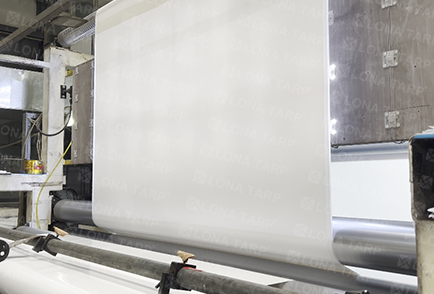
White PVC tarpaulin
  • The use of plasticizers that comply with environmental regulations (such as DOTP and citrate-based plasticizers)
  • The selection of higher-purity PVC resins and auxiliary materials with fewer impurities

Through these measures, eco-friendly PVC tarpaulins are able to maintain functional performance while more easily meeting material safety and environmental compliance requirements in major markets such as the European Union and the United States.

I. How Can PVC Tarpaulins Be Made Eco-Friendly?

Eco-Friendly Plasticizers

DOP (sometimes called DEHP), DBP, DINP, DIDP, DOTP, and DOA are common plasticizers used in PVC tarpaulins. Among them, DOP has long been regarded as one of the most popular plasticizers in the industry due to its processing stability, flexibility retention, and cost effectiveness.

However, as environmental regulations have tightened, DOP and certain traditional phthalate plasticizers have been listed as restricted or closely monitored substances. In some countries, markets, and application scenarios, their use is no longer permitted.

For PVC tarpaulin products that must comply with environmental regulations such as EN 71 and REACH, DOTP is commonly adopted as the primary alternative plasticizer. According to common industry terminology:

  • 6P compliant”: The total content of six restricted phthalates—DEHP, DINP, DBP, DIDP, DIBP, and BBP—does not exceed 0.1%.
  • “3P compliant”: Typically allows the presence of DINP, while other restricted phthalates are still subject to defined limits.

Note that “3P” and “6P” are colloquial acronyms used in the industry; they essentially refer to the phthalate limitations outlined in the EU REACH law and associated standards.

In addition, the dosage of plasticizers not only affects regulatory compliance but also directly determines the hardness, low-temperature flexibility, and overall handling feel of the PVC tarpaulin. Therefore, designing an appropriate plasticizer system according to different application scenarios—while staying within regulatory limits—is a key step in formulating eco-friendly PVC tarpaulins.

II. Certification Standards for Eco-Friendly PVC Tarpaulins

Whether a PVC tarpaulin is truly “eco-friendly” does not depend on a single raw material or test result. Instead, it requires comprehensive verification against multiple international regulations and compliance systems. Each regulation focuses on different aspects, but their shared goal is to minimize potential risks to human health and the environment throughout the material’s lifecycle.

REACH Regulation (EU)

REACH (Registration, Evaluation, Authorisation and Restriction of Chemicals) is a systematic chemical management regulation implemented by the European Union, covering the entire lifecycle of chemicals from production, import, use, to placement on the market.

In the context of PVC tarpaulins, REACH’s primary implications include:

  • REACHContinuous monitoring and control of SVHC (Substances of Very High Concern), including multiple phthalate plasticizers.
  • Setting explicit restrictions or usage requirements for certain chemicals.
  • Requiring supply chains to provide compliance declarations and ensure proper information flow.
When PVC tarpaulins are compliant with REACH, they either don’t contain any chemicals that are banned or extremely worrying at the raw material level, or their content falls within the regulation’s permitted levels. For environmentally friendly PVC tarpaulins to join EU markets, take part in project procurement, and form enduring relationships, this acts as a fundamental compliance need.

RoHS Directive (EU)

RoHS (Restriction of Hazardous Substances) was initially designed for electrical and electronic products, but its concept of limiting hazardous substances has been widely adopted in material and component procurement.

RoHS mainly restricts the content of the following substances:

  • RoHSLead (Pb)
  • Cadmium (Cd)
  • Mercury (Hg)
  • Hexavalent chromium (Cr⁶⁺)
  • Polybrominated biphenyls (PBB)
  • Polybrominated diphenyl ethers (PBDE)

For PVC tarpaulins, RoHS is mainly relevant in:

  • Whether the stabilizer system contains heavy metals.
  • Residual levels of restricted elements in raw materials and coatings.

PVC tarpaulins that use a calcium-zinc stabilizer system and control raw material sources typically meet RoHS heavy metal limits and are therefore considered a key reference for material environmental compliance.

CPSIA (US Consumer Product Safety Improvement Act)
CPSIA-1CPSIA is a US regulation focused on consumer product safety, particularly for products intended for children. However, parts of it are also applied to other products with high safety requirements.

In PVC materials, CPSIA mainly focuses on:

  • Strict limits on lead content.
  • Prohibition or restriction of certain phthalate plasticizers.

While not all PVC tarpaulins are required to comply with CPSIA, eco-friendly PVC tarpaulins that meet CPSIA requirements are more readily accepted in North American markets, public facilities, educational institutions, and other safety-sensitive applications.

EN 71 (EU Toy Safety Standard – Material Safety Reference)
cuboro-en71EN 71 is a European standard for toy safety, which includes clear requirements for heavy metal migration and phthalate content in materials.

In the PVC tarpaulin industry, EN 71 is often used as:

  • A reference for material safety.
  • A compliance guideline for materials intended for children, public activity areas, or temporary facilities.

When PVC tarpaulins are applied in children’s activity areas, schools, or other high-safety environments, meeting the relevant EN 71 requirements is generally considered a key indicator of both eco-friendliness and safety performance.


III. Applications of Eco-Friendly PVC Tarpaulins

As regulatory requirements and downstream industry standards continue to rise, eco-friendly PVC tarpaulins are gradually shifting from being a “value-added feature” to becoming a basic prerequisite in specific fields. Their applications are no longer limited to traditional covering purposes but are expanding into scenarios with high compliance and strict safety requirements.

Food-Grade Contact Packaging and Transportation

PVC tarpaulins are commonly used for moisture-proofing, dust protection, and temporary covering during the storage and transportation of food raw materials, semi-finished products, or packaged food. These applications require high chemical safety standards, and eco-friendly PVC tarpaulins often need to meet FDA requirements or equivalent food-contact regulations in addition to environmentally friendly formulations, reducing the risk of plasticizer or other substance migration.

Medical Equipment and Pharmaceutical Storage

The storage and logistics of medical equipment, pharmaceuticals, and related consumables demand strict environmental cleanliness and material safety. Eco-friendly PVC tarpaulins, with their low heavy-metal content and minimal restricted plasticizers, are better suited for applications such as medical storage partitions, equipment covers, and temporary protective barriers.

Children’s Activity Areas and Educational Facilities

EN 71-2

In spaces such as children’s activity areas, temporary school facilities, and outdoor classrooms, tarpaulin materials are frequently touched. These applications are highly sensitive to phthalate and heavy metal migration, and compliance with standards such as EN 71 and CPSIA makes eco-friendly PVC tarpaulins a safer and more reliable choice.

High-End Electronics and Luxury Goods Logistics

High-end electronics and luxury goods require careful control over material compliance and brand-related risks during logistics and storage. Using PVC tarpaulins that comply with REACH and other environmental standards helps mitigate potential compliance risks and meets international brand requirements for supply chain material auditing.

Green Building and Construction Project Sites

In construction projects pursuing LEED or other green building certifications, temporary covering materials used on site are also evaluated for environmental impact. Eco-friendly PVC tarpaulins, due to their compliant formulations and traceable raw materials, are more likely to satisfy green building projects’ overall material sustainability and environmental requirements.

IV. Conclusion

Eco-friendly PVC tarpaulins are more than a material upgrade—they represent a systematic approach to raw material selection, formulation design, regulatory compliance, and application-specific adaptation. By replacing restricted plasticizers with environmentally safer alternatives like DOTP, adopting non-heavy-metal stabilizers such as calcium-zinc systems, and complying with international standards like REACH, RoHS, CPSIA, and EN 71, these tarpaulins ensure both performance and safety.

As global regulations tighten and downstream industries demand higher compliance, eco-friendly PVC tarpaulins are increasingly becoming a baseline requirement for applications ranging from food-grade transport to medical storage, children’s facilities, high-end logistics, and sustainable construction projects. Their adoption not only mitigates potential health and environmental risks but also positions manufacturers and users to meet the expectations of international markets and eco-conscious clients.

In short, investing in eco-friendly PVC tarpaulins is a proactive step toward durable, safe, and sustainable solutions in diverse industrial and commercial scenarios.

Share Thisw Story:

Table of Contents

祁欣煜

Felicia Qi

I am Felicia. I have been working in the PVC tarpaulin industry at Haining Lona Coated Material Co., Ltd. for nearly 10 years.With nearly 20 years of experience in the textile foreign trade industry. I am confident that my professional expertise and high-quality products will win your trust.

Try LonaTarp® Customize Your Tarpaulin Now

Get A Quote

Fill out the form below, and we will be in touch shortly.