Inflatable Construction Tent and Bubble Structure Applications

Home > Product Knowledge & Application > Inflatable Construction Tent and Bubble Structure Applications

Flexible, quick-deploying enclosure solutions are more important than ever as building projects get more complicated and deadlines are tighter. Conventional steel-frame temporary structures can have lengthy installation schedules, high labor costs, and shipping expenses. On the other hand, inflatable buildings offer a contemporary substitute that puts an emphasis on operational effectiveness, speed, and adaptability.

The Bubble Structure and the inflatable construction tent are two of the most popular choices. These air-supported enclosures are designed to save setup time and structural complexity while producing sturdy, weatherproof working spaces. They are becoming more and more common in emergency response applications, industrial operations, infrastructure maintenance, and construction because to their versatility.

Unlike rigid structures, inflatable systems rely on controlled internal air pressure combined with high-strength technical fabrics. This design approach allows them to be lightweight yet robust, portable yet durable. As a result, inflatable enclosures are no longer viewed as temporary stopgaps, but as strategic tools that help companies reduce downtime, improve safety, and maintain productivity in challenging environments.

This article provides a comprehensive overview of inflatable construction tents and bubble structures, explaining how they work, where they are commonly used, and which materials are best suited to ensure long-term performance.

I. What Is an Inflatable Construction Tent?

Definition and Structural Principle

An air-supported covering made especially toInflatable Construction Tent safeguard industrial or building sites is known as an inflatable construction tent. Its construction is made up of air chambers or inflatable beams that are kept rigid by constant air pressure from electric blowers. When the tent is inflated, it forms a sturdy structure that can handle moderate snow loads, wind, and rain.
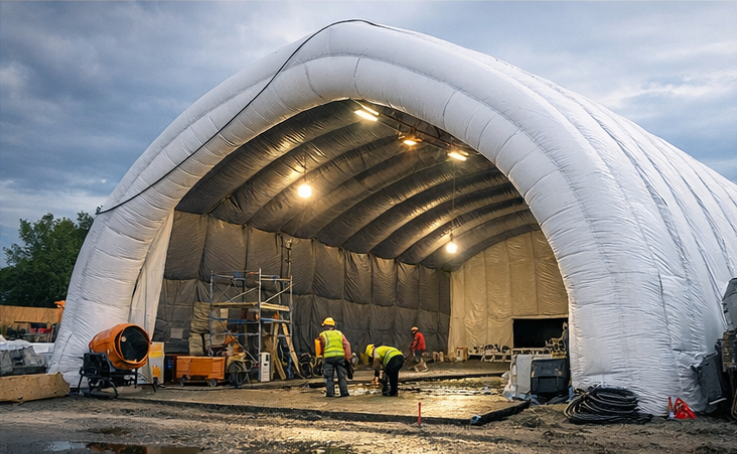
In contrast to conventional temporary structures, an inflatable construction tent doesn’t need steel frames or bulky foundations. This greatly simplifies the installation process and makes it possible to use the structure on constrained urban job sites, roofs, rough terrain, and bridges—places where traditional structures would not be practical

Operational Benefits on Construction Sites

The capacity of an inflatable construction tent to be quickly deployed is one of its biggest benefits. Installation may frequently be finished in a matter of hours as opposed to days. This speed is very beneficial in time-sensitive tasks like emergency repairs, infrastructure maintenance, or temporary building phases.

Inflatable construction tents provide superior environmental control in addition to speed. They shield workers and materials from precipitation, wind, dust, and extreme temperatures by enclosing the work area. This increases schedule dependability and lowers costly delays by enabling construction activities to proceed regardless of the outside weather.

Safety, Efficiency, and Customization

From a safety perspective, inflatable construction tents help to establish a controlled working environment. They can be equipped with ventilation, lighting, and temperature controls, improve visibility, and reduce exposure to external hazards. When doing specific tasks like painting, welding, surface preparation, or concrete drying, it is essential to maintain consistent weather conditions for both quality and worker safety.

Inflatable construction tents may also have their internal configuration, dimensions, and shape customized. Access doors, material handling apertures, and connection tunnels can all be integrated to suit a project’s specific requirements.

II.What Is a Bubble Structure?

One particular kind of inflatable enclosure that isBubble Structure distinguished by its spherical or dome-shaped geometry is called a Bubble Structure. In addition to being aesthetically pleasing, its design is structurally efficient. Stability and resistance to wind and snow buildup are improved by the uniform distribution of external stresses and interior pressure across the curved surface.
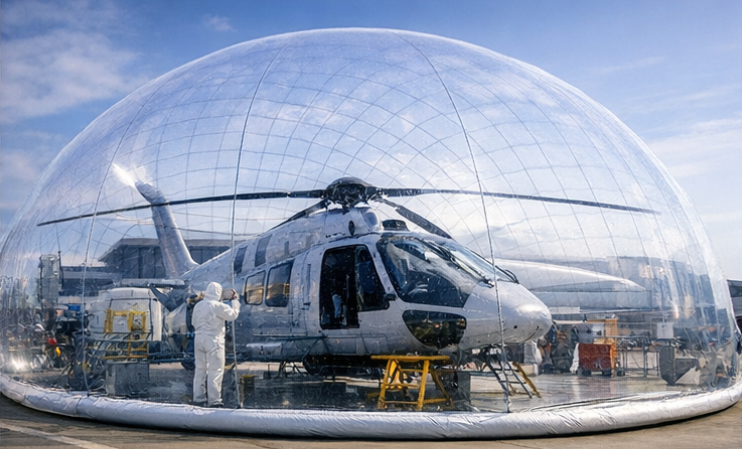
This shape makes bubble structures especially appropriate for large-span enclosures when open interior space is a requirement, since they often require less reinforcing than rectangular inflated tents.

Functional Differences Compared to Construction Tents

Bubble structures frequently strike a balance between functionality and spatial experience, whereas inflated construction tents are primarily designed for practicality and site protection. Their open, column-free interiors provide greater freedom for arranging large equipment, temporary workshops, or collaborative workspaces.

Transparent or translucent membranes are used in some Bubble Structure designs to allow natural light inside the enclosure. This creates a more pleasant work environment while also lowering the demand for artificial lighting.

Adaptability Across Multiple Industries

From construction and industrial maintenance to exhibits and public gatherings, a bubble structure may be employed in a variety of fields. Because of its modular design, which enables it to be enlarged, moved, or used again for different projects, it is an affordable long-term investment for businesses that frequently need temporary enclosures.

III.Typical Applications and Use Scenariosv

Construction and Infrastructure Maintenance

In infrastructure projects including bridge repair, tunnel maintenance, railroad work, and road resurfacing, inflatable construction tents are frequently utilized. These enclosures shield workers from the elements and prevent contaminants or debris from leaking into neighboring areas by enclosing the work area.

Inflatable tents are especially useful for preserving ideal curing conditions for materials like concrete, paints, and adhesives in cold or humid regions, guaranteeing consistent quality independent of outside factors.

Industrial Maintenance and Equipment Servicing

Inflatable enclosures are commonly used in industrial settings for equipment installation, overhaul, and shutdown maintenance. When covering massive machinery, turbines, or industrial lines, a bubble structure works particularly well since it provides sufficient interior volume without intrusive supports.

By enabling repair operations to continue regardless of the general factory conditions, these enclosures contribute to reducing production downtime.

Environmental Containment and Regulatory Compliance

Environmental protection is an increasingly important consideration in construction and industrial projects. Inflatable construction tents can be equipped with air filtration and pressure control systems to capture dust, fumes, or hazardous particles generated during demolition, blasting, or surface treatment operations.

By creating a sealed and controlled environment, these structures help companies comply with environmental regulations while improving site cleanliness and safety.

Events, Exhibitions, and Temporary Facilities

Additionally, bubble structures are frequently used in temporary public spaces, promotional events, and exhibits. Their distinctive appearance draws attention, and they are perfect for temporary usage due to their quick installation and removal.

Emergency Response and Rapid Deployment Scenarios

Inflatable construction tents can be used as temporary medical stations, command centers, or storage spaces during emergency response and disaster relief operations. They are extremely useful in situations when infrastructure is unavailable or compromised due to their lightweight design and rapid deployment capabilities.

IV.Suitable Materials for These Structures

PVC-Coated Polyester Fabric

The most popular fabric for inflatable construction tents and bubble structures is polyester with a PVC coating. Tensile strength is provided by the polyester base fabric, while chemical, UV, and waterproof protection are provided by the PVC coating.

Higher GSM PVC textiles are recommended for demanding industrial applications because of their exceptional abrasion resistance and durability.

Reinforced and Multi-Layer Technical Fabrics

Reinforced technical textiles with scrim or multi-layer structure are frequently used in large-scale Bubble Structure installations. These materials improve structural stability and tear resistance under constant air pressure, helping to prolong service life under challenging conditions.

Transparent and Translucent Membrane Options

Bubble constructions are increasingly using transparent and translucent membranes to enhance internal illumination. These materials are appropriate for both industrial and event-related applications because they strike a balance between visibility, insulation, and UV protection.

Fire-Retardant and Certified Materials

When it comes to inflatable enclosures, safety compliance is crucial. Fire-retardant materials that satisfy international standards such as B1, M2, or NFPA are used in the production of the majority of inflatable construction tent systems. In addition to guaranteeing safety, certification increases usage across geographies and sectors.

V.Conclusion

Strategic Value of Inflatable Enclosure Solutions

Systems for inflatable enclosures have developed into reliable, high-performing answers to contemporary industrial and construction problems. While the Bubble Structure offers spacious interiors, structural integrity, and visual impact, the inflatable construction tent delivers unparalleled efficiency, environmental control, and site adaptation.

Businesses may greatly increase project productivity, safety, and cost management by choosing the right construction type and material specifications. Inflatable structures are expected to become more and more significant in a variety of international businesses as the need for adaptable and sustainable building solutions grows.


Share Thisw Story:

Table of Contents

陈玲

Lynn Chen

I’m Lynn from Haining Lona Coated Material Co. For years, I’ve been helping customers find the right PVC coated fabric and related products for their projects. Whether it’s for inflatables, tents, or industrial covers, I’m here to share ideas, answer questions, and make sure you get the right solution. Feel free to reach out — I’m always happy to talk.

Try LonaTarp® Customize Your Tarpaulin Now

Get A Quote

Fill out the form below, and we will be in touch shortly.