

Method for Calculating the Quantity of Tarpaulin Rolls in a Container.
Table of Contents
Determining the quantity of PVC tarpaulin rolls—typically transported in rolls or bundles—that can be loaded into a container is a comprehensive process of spatial optimization. It requires a detailed analysis of the cargo’s physical properties, its packaging specifications, and the precise dimensions of the container itself. The ultimate objective is to calculate the maximum number of tarpaulin units that can be efficiently accommodated within a single container, thereby maximizing logistical efficiency and cost-effectiveness.
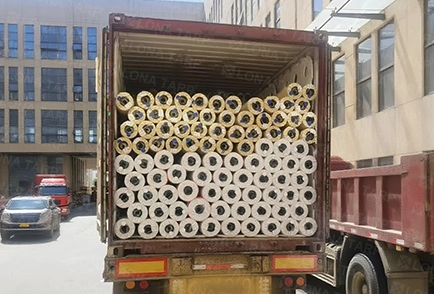
Determining the quantity of PVC tarpaulin rolls—typically transported in rolls or bundles—that can be loaded into a container is a comprehensive process of spatial optimization. It requires a detailed analysis of the cargo’s physical properties, its packaging specifications, and the precise dimensions of the container itself. The ultimate objective is to calculate the maximum number of tarpaulin units that can be efficiently accommodated within a single container, thereby maximizing logistical efficiency and cost-effectiveness.
This calculation involves a series of methodical steps. Key parameters such as the exact diameter, length, and weight of each roll or bundle must be accurately measured. These dimensions are then carefully mapped against the container’s internal cubic capacity, structural load-bearing limits, and practical loading constraints. Through careful planning and spatial modeling, the most optimal loading arrangement is identified to utilize every possible inch of space without compromising the cargo’s safety.
Mastering this systematic approach is crucial for supply chain management. It directly translates to reduced shipping costs, improved container utilization rates, and provides reliable data for planning secure and efficient transportation.
I. Confirm the Basic Data for Loading Rolled Tarpaulin Into Containers.
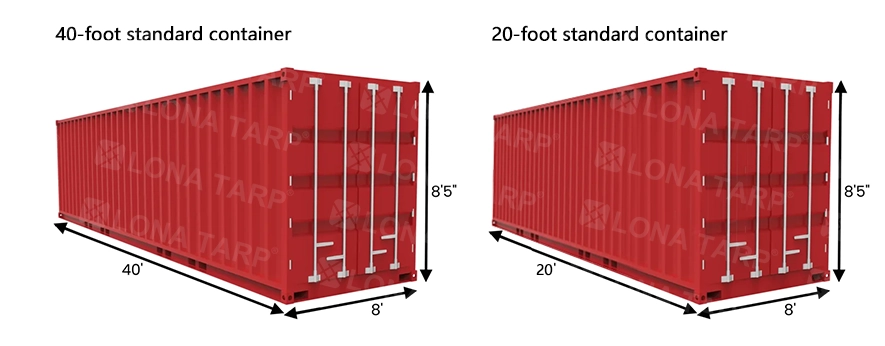 Accurate planning begins with gathering precise foundational data. The first critical component is the container specifications. The most frequently used options are the 20-foot standard container (20’GP), with an internal volume of approximately 33 cubic meters, and the 40-foot standard container (40’GP), offering about 67 cubic meters of space. It is essential to note that these dimensions can vary slightly between different container models and manufacturers. Therefore, confirming the exact internal length, width, and height with your shipping company or freight forwarder is a crucial step to ensure the accuracy of all subsequent calculations.
The second component involves defining the rolled tarpaulin packaging specifications. You must accurately measure the external dimensions of a single roll or bundle—its length (L), width (W), and height (H). For consistency and ease of calculation, it is highly recommended to use meters (m) as the unit of measurement. For instance, a common rolled tarpaulin package might have dimensions of L=0.8m, W=0.8m, H=0.6m. With these figures, you can then calculate the unit volume using the formula L × W × H, which in this example would be 0.384 cubic meters.
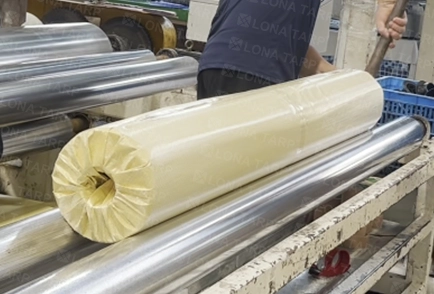
Beyond volume, the unit weight of each rolled tarpaulin package must be established. This is a vital piece of information, as it will be used later to check against the container’s maximum payload capacity. Overlooking weight restrictions can lead to logistical complications and additional costs, making this step as important as the volumetric calculation for safe and compliant shipping.
II. Core Calculation Method (Theoretical Calculation)
 The theoretical calculation aims to establish a baseline for the maximum number of units by treating the container’s interior as a perfect rectangular prism. The fundamental approach is the “spatial division method”, which systematically divides the container’s dimensions by the cargo’s dimensions.
The Core Formula & Logic
The underlying calculation is straightforward:
Total Quantity ≈ (Container Length / Tarpaulin Length) × (Container Width / Tarpaulin Width) × (Container Height / Tarpaulin Height)
However, applying this formula requires a strategic process to find the most efficient configuration.
Detailed Calculation Steps
Determine Orientation and Plan
The key to maximizing space is to experiment with how the PVC tarpaulin fabric roll unit is positioned within the container. The unit’s length (L), width (W), and height (H) can be aligned with any of the container’s three primary dimensions. Each unique combination is considered a separate “loading plan.”Calculate Units per Dimension
For a given loading plan, calculate how many units fit along each of the container’s axes. It is critical to round down each result to the nearest whole number, as partial units cannot be loaded.Units along length = Round Down(Container Inner Length / Tarpaulin roll dimension aligned with length)
Units along width = Round Down(Container Inner Width / Tarpaulin roll dimension aligned with width)
Units along height = Round Down(Container Inner Height / Tarpaulin roll dimension aligned with height)
Calculate Total for the Plan
Multiply the three results from the previous step to get the theoretical maximum quantity for that specific orientation.
Total Units = (Units on Length) × (Units on Width) × (Units on Height)Iterate and Optimize
Repeat steps 2 and 3 for several different orientations of the PVC tarpaulin in roll unit. For instance, first align the unit’s long side with the container’s length, then try aligning its short side with the length. The goal is to compare the results of all viable plans and select the one that yields the highest number.
Practical Calculation Example (Using 20’GP and a sample tarpaulin unit)
Container (20’GP): 5.9m (L) x 2.35m (W) x 2.39m (H)
Tarpaulin Roll Unit: 0.8m (L) x 0.8m (W) x 0.6m (H)
Plan 1: Standard Orientation (L aligned with Container Length)
Length (5.9m): 5.9 / 0.8 = 7.375 → 7 units
Width (2.35m): 2.35 / 0.8 = 2.937 → 2 units
Height (2.39m): 2.39 / 0.6 = 3.983 → 3 units
Total for Plan 1: 7 × 2 × 3 = 42 units
Plan 2: Alternative Orientation (H aligned with Container Length)
Note: This plan is primarily for comparison. Using the smallest dimension (H) as the base for stacking may raise stability concerns and is often less optimal.
Length (5.9m): 5.9 / 0.6 = 9.833 → 9 units
Width (2.35m): 2.35 / 0.8 = 2.937 → 2 units
Height (2.39m): 2.39 / 0.8 = 2.987 → 2 units
Total for Plan 2: 9 × 2 × 2 = 36 units
Conclusion: By comparing the results, Plan 1 yields a higher theoretical maximum of 42 units and is therefore the superior configuration for this example. This process demonstrates how a simple change in orientation can significantly impact the final load count.
III. Verification and Adjustment for Practical Conditions
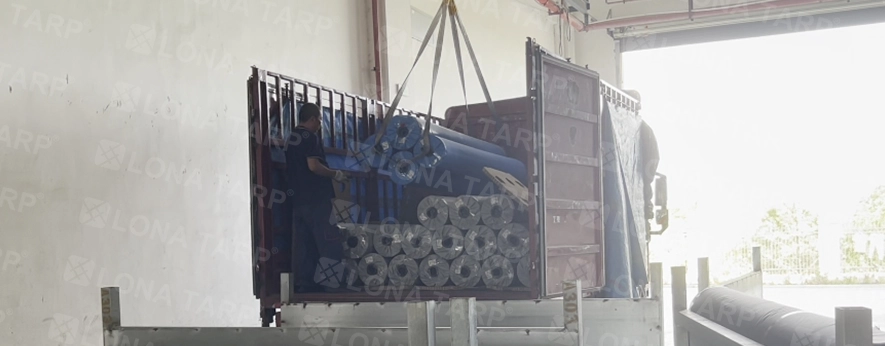 The theoretical maximum quantity serves as a starting point, but real-world constraints often necessitate adjustments. A comprehensive verification against these practical conditions is essential to finalize a viable loading plan.
1. Weight Limit: The Critical Constraint
The first and most crucial check is against the container’s maximum payload.
Calculation: Total Weight = Unit Weight × Theoretical Quantity
Verification: Compare this total against the container’s weight limit (e.g., approximately 28 tons for a 20’GP, 26 tons for a 40’GP) and any route-specific regulations.
Outcome: If the cargo is weight-bound, the weight limit takes absolute priority. The final quantity must be reduced to comply, even if there is unused space.
2. Volume Limit: Accounting for Unfillable Space
While the calculation assumes perfect space utilization, reality is less efficient.
Calculation: Total Volume = Unit Volume × Theoretical Quantity
Verification: Compare this to the container’s internal volume. In practice, due to gaps between items and irregular shapes, the practical loading efficiency is typically 90-95% of the theoretical volume.
Outcome: For volume-bound cargo, the actual load may reach this practical volume ceiling before the container is physically full or the weight limit is reached.
3. Practical Loading and Safety Factors
Finally, several physical factors can further reduce the load count from the theoretical ideal:
Cargo Deformation & Compressibility: While PVC tarpaulin rolls may allow for minimal over-packing due to slight compression, this should not be a primary strategy as over-compression can damage goods.
Inevitable Space Wastage: The presence of corrugated walls, rounded corners, and door protrusions means not all theoretical space is usable.
Loading Safety and Stability: Safe transport is paramount. This includes:
Stable Stacking: Preventing collapses during transit may require the use of dunnage (e.g., airbags, wooden braces).
Adequate Clearance: Sufficient space must be left between the cargo and the container roof to prevent damage.
Packaging Uniformity: Minor inconsistencies in roll diameter or bundle dimensions can compound, causing the actual stack to deviate from the perfect grid assumed in the theoretical model.
By systematically addressing these factors, you can refine the theoretical calculation into a safe, practical, and executable loading plan.
IV. Summary: Achieving an Optimal Loading Plan
To determine the most accurate and practical loading quantity, a multi-faceted approach is essential. The most reliable method integrates three key components:
Rigorous Theoretical Calculation: Begin by comparing multiple orientation plans to establish a theoretical baseline, identifying the most space-efficient arrangement.
Critical Reality Checks: Validate this theoretical maximum against hard constraints, primarily the container’s weight limit and the practical volume limit, adjusting the quantity accordingly.
Informed Practical Adjustment: Finally, incorporate lessons from real-world experience to account for factors like stability, safety, and packaging variations.
For high-value or complex shipments, conducting a 3D simulation using scaled models or professional loading software is highly recommended to visualize and resolve potential issues. Ultimately, the final confirmation from experienced loaders or your logistics provider is the definitive step to ensuring a plan that is not only efficient but also safe and executable.
Share Thisw Story:

I am Linda Yu. I have been working in the PVC tarpaulin industry at Haining Lona Coated Material Co., Ltd. for nearly 10 years.With nearly 20 years of experience in the textile foreign trade industry. I am confident that my professional expertise and high-quality products will win your trust.