The Truth Behind PVC Vinyl Tarpaulin Discoloration.

Home > Product Knowledge & Application > The Truth Behind PVC Vinyl Tarpaulin Discoloration.

Table of Contents

The Truth Behind PVC Vinyl Tarpaulin Discoloration: How to Avoid Color Change Losses and Enhance Product Competitiveness?

Scientific Formula + Professional Craftsmanship = Durable and Long-Lasting Tarpaulin Solutions

I. Why Are Your Laminated PVC Tarpaulin Customers Always Complaining About Discoloration?

blue tarpaulin rollEarly morning sunlight streams into the warehouse, but Mr. Zhang, a building materials distributor, frowns—the edges of the blue laminated PVC tarpaulins he stocked just three months ago are already showing obvious reddish-brown patches.

A similar issue troubles a construction contractor: the bright green PVC canvas tarpaulins purchased last year for site covering developed patchy red discoloration after just one summer, leading to customer complaints and claims.

These scenarios play out daily in building material markets and construction sites worldwide. Industry statistics show that over 35% of tarpaulin after-sales disputes stem from material discoloration, causing not only direct financial losses but also severe damage to brand reputation. As a key player in the tarpaulin supply chain, do you truly understand the underlying causes and solutions?

This article delves into the scientific reasons behind laminated PVC tarpaulin discoloration and provides actionable business solutions for different industry stakeholders—whether manufacturers, traders, or engineering service providers—to reduce complaints and enhance product value.

II. The Four Scientific Causes of PVC Canvas Tarpaulin Discoloration and Their Business Impact

(1) Thermal-Oxidative Degradation: The Fatal Weakness of Molecular Structure

PVC begins to soften at temperatures above 70°C, and at over 100°C, dehydrochlorination occurs, forming conjugated polyene structures (-C=C-C=C-). As double bonds increase, the color shifts from yellow to red and brown.

Impact on Your Business:

  • Manufacturers: Warehouse temperatures in summer can exceed 70°C. Untreated PVC canvas tarpaulins pre-age during storage, degrading material performance and leading to yellowing, cracking, and reduced lifespan.
  • Distributors: Tarpaulin product discoloration increases rejection rates, leading to higher returns, damaged sales performance, and brand image. Strengthen communication with coated PVC fabric tarpaulin manufacturers to ensure stable quality.
  • Contractors: Discoloration on-site leads to failed project acceptance, quality claims, and reputational damage. Enhance quality checks during procurement and usage.
tarp roll

(2) Additive Failure: The Hidden Cost Trap

  • Plasticizer migration: Phthalate plasticizers migrate to the surface at high temperatures, oxidizing and turning yellow/red.
  • Antioxidant depletion: Low-cost antioxidants (e.g., BHT) form quinone structures under UV light, causing “pinking.”
  • Insufficient stabilizers: Calcium-zinc stabilizers in inadequate amounts fail to neutralize released HCl.

Comparison of Stabilizer Performance:

Stabilizer Type

Heat Resistance

Discoloration Resistance

Eco-Friendliness

Cost Index

Lead-based

High

High

Poor

Medium

Organotin

Very High

Excellent

Moderate

High

Calcium-Zinc

Medium

High

Good

Medium-High

Rare Earth

High

High

Good

Medium-High

(3) Environmental Stress: The Brutal Test of Real-World Use

  • UV radiation: UV photons break molecular chains, creating free radicals (risk doubles in regions with ≥120kLy annual radiation).
  • Temperature/humidity cycles: Day-night thermal expansion accelerates cracking.
  • Pollutants: Industrial SO₂ and acid rain accelerate aging.

(4) Process Flaws: Hidden Production Risks

  • Uneven mixing: Poor stabilizer dispersion creates weak spots.
  • Overheating: Extrusion temperatures >190°C trigger degradation.
  • Residual stress: Rapid cooling causes internal stress concentration.

III. How PVC Coated Polyester Tarpaulin Discoloration Erodes Your Profits—Pain Points for Different Stakeholders

(1) Manufacturers: The Dilemma Between Cost and Quality

One PVC tarpaulin fabric factory used low-cost recycled materials, causing an entire batch to turn red during storage, resulting in ¥800K losses. Worse:

  • Lost trust: The factory’s long-term clients, who had relied on the company for consistent quality, were deeply disappointed. As a result, many of these clients canceled their orders, leading to a 30% drop in overall sales. This loss of trust was not only a short-term financial hit but also a long-term setback, as regaining the confidence of these clients would be a challenging and time-consuming process.
  • Rework costs surged: The factory was forced to incur substantial rework costs. This included the disposal of the scrap material, which was now worthless, and the labor required to reprocess the defective PVC coated polyester tarpaulins. These additional expenses further strained the factory’s financial resources and operational efficiency.
  • Legal risks: The incident also exposed the factory to legal risks. Clients who had received the defective PVC vinyl tarpaulins could seek compensation through contract penalties or even file lawsuits. The potential for legal action added another layer of complexity and financial burden to the already dire situation.

LonaTarp® Factory uses exclusively brand-new S-70 and S-80 grade PVC resin for all orders and rejects the use of recycled materials.

(2) Distributors: Inventory Depreciation and Customer Churn

PVC vinyl tarpaulinsA building materials wholesaler recently faced a severe challenge: it had 300 rolls of color-changing PVC vinyl tarpaulins in stock. Due to the product’s color change, these goods did not sell as quickly as expected, forcing the wholesaler to take extreme measures to resolve the inventory issue. Ultimately, they decided to clear the stock at 40% of the original price. Although this move helped alleviate the inventory pressure, it also brought about various negative impacts on the business:

  • Inventory Turnover Rate: The low-price sale directly led to a significant decrease in the company’s inventory turnover efficiency. Specifically, the company’s inventory turnover rate dropped from a relatively healthy 4 times per year to 2.5 times. This means that the company now takes longer to convert its inventory into cash or accounts receivable, increasing the cost of capital tied up and reflecting a slowdown in product sales.
  • Loss of High-Quality Customers: This incident also had an adverse effect on customer relationships. Observations show that the churn rate for high-quality customers reached 15%, indicating that a substantial number of long-term, high-purchasing-power customers have switched to other suppliers for various reasons (such as price changes, quality concerns, etc.). Losing these loyal customers not only immediately reduces sales but also poses a potential threat to future business development.
  • Decrease in Profit Margin: The clearance action significantly compressed the company’s profit margin. Data shows that compared to normal operating levels, the current profit margin has decreased by more than 30%. For any business, profit is one of the key indicators of its operational health, and such a significant decline undoubtedly presents a serious challenge to the company’s short-term and long-term profitability.

(3) Contractors: Project Risks and Brand Damage

Taking a construction site as an example, the use of substandard tarpaulins (a large number of PVC vinyl tarps turned red in a short period) led to a series of chain reactions, resulting in significant economic and reputational losses for the engineering service provider.

construction site tarpaulin

  • Failure of Covering Function: The PVC coated polyester tarpaulins used at the site changed color and lost their water-resistant properties within a short time. This directly resulted in the equipment under cover not being effectively protected. During adverse weather conditions, rainwater seeped into the equipment, causing 530,000 RMB worth of damage. This substantial compensation not only increased the project’s costs but also highlighted potential issues with the company’s supplier vetting process.
  • Penalties for Project Delays: The need to repair damaged equipment and replace it with new, reliable PVC vinyl tarpaulin material forced the entire construction schedule to be delayed. According to the contract terms, a penalty of over 20,000 RMB per day of delay was imposed. This means that even after the problem is resolved, the company will still face additional costs due to the delay, further squeezing the project’s profit margins.
  • Decline in Corporate Credit Rating: Such incidents not only have a negative impact on the current project but also, in the long term, harm the company’s reputation within the industry. When potential clients learn about this situation, they may doubt the company’s professional capabilities and service quality, affecting future bidding opportunities. Furthermore, if the company’s poor record is entered into relevant credit evaluation systems, it could lead to a decrease in its credit rating, which in turn affects financing channels and partner selection.
IV. Professional PVC Tarpaulin Waterproof Solutions: Blocking Discoloration at Its Root

(1) Advanced Material Formulations (For Manufacturers)

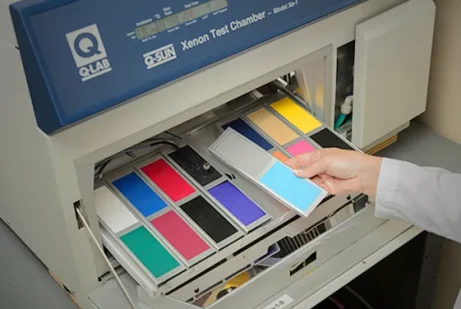
Our quadruple-protection system passes 2000h QUV aging tests:

  • Thermal barrier: Organotin + rare earth stabilizers (120°C threshold).
  • UV defense: Nano rutile TiO₂ + hindered amine light stabilizers.
  • Structural reinforcement: High-polymer PVC resin (K-value ≥70).
  • Self-healing network: Elastomer modifiers repair micro-cracks.
Xenon lamp aging boxs

Performance Comparison by Weight:

Weight (g/m²)

Standard Lifespan

Enhanced Lifespan

Premium Pricing

<500

6-12 months

24-36 months

+40-60%

500-600

1-1.5 years

3-4 years

+50-70%

600-800

1.5-2 years

4-5 years

+60-80%

>800

2-3 years

5-7 years

+70-100%

(2) Smart Process Control (For Manufacturers)

  • Precision temp control: Co-extrusion die zones (±1°C accuracy).
  • Real-time monitoring: IR spectroscopy detects degradation.
  • Post-treatment: Fluoropolymer coating (300% weather resistance boost).

(3) Distributor Support System

  • Quality insurance: 2-year discoloration coverage.
  • Pre-sale warehousing: Zero inventory risk.
  • Marketing tools: Free aging comparison kits + whitepapers.

(4) Contractor Services

  • Climate-tailored formulas: Region-specific solutions.
  • Emergency supply: 72-hour rapid replenishment.
  • Bid support: Technical documentation for tenders.

CTA (Call to Action):

📞 Call/WhatsApp: +86-17757389172
📧 Email: sam@pvctarpaulin.com
🌐 Website: www.pvctarpaulin.com

About Us:
With 13 years in high-performance PVC vinyl tarpaulin manufacturing, we serve 200+ quality-driven partners globally. Our ISO9000-certified production lines and deep technical expertise ensure solutions that safeguard your business success.

Pro Tip: Save or share this article with your procurement, technical, or project teams. Make scientifically informed choices—starting with your next inquiry.

Share Thisw Story:

df6390e5d02cb1faa211814b47f3a9e

Hi, I’m Sam Tan, International Sales at Haining Lona Coated Materials. With 10 years of foreign trade experience in PVC tarpaulin, I have deep product knowledge. Backed by our 20+ years of factory expertise in PVC coating technology (100+ employees), I ensure reliable solutions. Let’s connect!