

What Is Anti-Static Tarpaulin?
Static electricity is an unseen but extremely dangerous hazard in contemporary industrial production and precision manufacturing.
Ordinary industrial tarpaulins provide decent protection from rain, dust, and UV rays, but they can inadvertently become static charge generators, building up thousands or even tens of thousands of volts due to handling, airflow, and friction. A unique industrial protective material called anti-static tarpaulin was created especially to remove this potential hazard.
It describes tarpaulin textiles coated with PVC that have undergone specific physical or chemical treatments that allow static charges to quickly disperse rather than build up. This is a significant development in industrial safety management and high-value asset protection, not just a material enhancement.
I. Which Industries Must Use Anti-Static PVC Tarpaulin?
In certain industries, static electricity is not just a nuisance—it is a direct safety hazard. In these fields, the use of anti-static tarpaulin is not optional but often mandatory under safety regulations.
Electronic Components & Precision Equipment Manufacturing and Storage
Precision sensors, control modules, integrated circuits, and semiconductors are all highly susceptible to electrostatic discharge (ESD).
Microscopic circuit architectures can be instantaneously destroyed by even small static discharges caused by human movement or material friction, leading to hidden flaws or permanent damage.
Furthermore, airborne dust and microparticles are drawn to cleanroom environments by static electricity, which lowers product output.
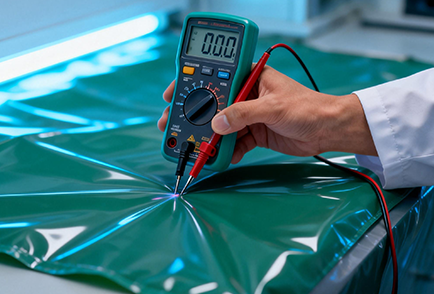
Because it provides a vital electrostatic protection barrier for expensive electronics, anti-static PVC tarpaulin is frequently utilized in raw material storage, work-in-process facilities, equipment covers, cleanroom partitions, and completed product warehouses.
Flammable and Explosive Hazardous Materials Storage & Transportation
One of the most important uses for anti-static tarpaulin is this.
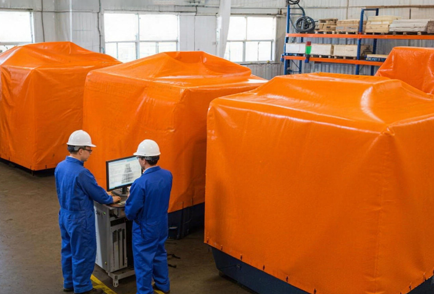
Flammable liquids, vapors, gases, or dust are frequently found in industries such petrochemical processing, chemical production, handling natural gas, powder processing, and defense applications. Static electricity can be produced by regular tarpaulins through truck movement, loading and unloading, and wind friction. An explosion or fire could result from a single static spark acting as an ignition source.
Anti-static PVC tarpaulin is frequently paired with flame-retardant qualities for these uses, guaranteeing concurrent defense against fire and electrostatic discharge risks.
Logistics, Warehousing & High-Value Cargo Protection
With the increasing automation of global logistics, the transportation of high-end machinery, precision instruments, and premium textiles has grown rapidly.
Static electricity can:
- Interfere with electronic control units
- Attract dust to polished metal or optical surfaces
- Damage sensitive coatings and fabrics
Anti-static PVC tarpaulin is crucial for high-value international logistics because it guarantees that goods arrive clean, undamaged, and fully functional even after long-distance transit when used as cargo covers, vehicle liners, or warehouse partitions.
II. The Serious Hazards of Static Electricity
Understanding the risks of static electricity is fundamental to appreciating the value of anti-static tarpaulin.
Direct Damage to Products and Equipment
Extremely high voltage and localized heat can be released quickly by electrostatic discharge.
This could result in circuit burnout, dielectric breakdown, or performance degradation for microelectronic components. Even frequent low-level ESD incidents can shorten service life and hasten aging.
Static sparks can cause burn marks, surface flaws, or localized exposure damage in businesses that deal with films, plastics, or coated materials.
Fatal Threats to Production Safety
This is the most severe risk.
Static discharge can act as an ignition source and cause fires or explosions in settings with flammable gasses, vapors, or combustible dust. These accidents, which frequently have disastrous outcomes, are well documented in mining operations, petrochemical factories, grain processing facilities, and chemical warehouses.
Continuous Interference with Production Efficiency and Quality
Products including optical lenses, wafers, coated metal parts, and painted surfaces are contaminated by static electricity because it draws in dust and other small particles.
Static can lead to feeding errors, machine stoppages, and decreased productivity in automated production lines by causing films, papers, or fibers to cling, repel, or tangle.
III. How Anti-Static PVC Tarpaulin Works
Anti-static PVC tarpaulin does not “block” static electricity. Instead, it controls and dissipates it, preventing dangerous accumulation.
There are two primary technical approaches.
Volume Conductive (Internal Additive) Technology
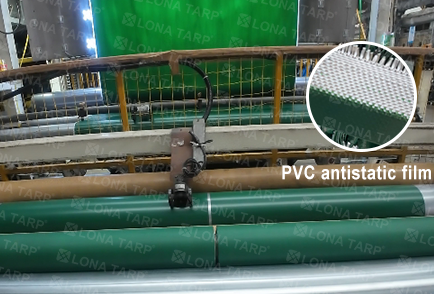
Conductive components are uniformly included into the PVC coating or polyester base fabric during production.
Common additions include permanent anti-static polymers, metal oxides (such antimony-doped tin oxide), and conductive carbon black.
Because these materials form a three-dimensional conductive network inside the tarpaulin, static charges can safely dissipate.
Advantages:
- Long-lasting and stable anti-static performance
- Resistant to washing, abrasion, and environmental changes
- Considered a permanent anti-static solution
Surface Coating (Post-Finishing) Technology
This method uses coating or cushioning techniques to give the finished tarpaulin’s surface an anti-static covering.
Usually, the coating is made up of hydrophilic surfactants that take in moisture from the air and create a thin layer of conductivity on the surface.
Limitations:
- Performance depends heavily on ambient humidity
- Effectiveness decreases in dry environments
- Anti-static properties diminish over time due to wear and cleaning
This method is generally regarded as temporary or semi-durable.
IV. Key Performance Standards for Anti-Static PVC Tarpaulin
To determine whether an anti-static tarpaulin is truly effective, measurable technical standards are essential.
Surface Resistivity
Surface resistivity is the most critical indicator of anti-static performance, reflecting how easily static charges can dissipate across the material surface.
Recommended Safe Range:
An effective anti-static PVC tarpaulin should maintain surface resistivity between
10⁶ Ω and 10⁹ Ω
- Below 10⁶ Ω: Excessive conductivity, potential leakage risk
- Above 10⁹ Ω: Insufficient dissipation, static accumulation remains possible
Testing Standards:
Measurements are typically conducted in accordance with GB/T 1410-2006 or IEC 60093, under controlled environmental conditions (e.g., 23 ± 2 °C, 50 ± 5% RH) using professional resistivity testing instruments.
For critical industrial applications, additional indicators may be evaluated, such as:
- Static voltage half-life (commonly required to be < 2 seconds)
- Surface charge density (e.g., ≤ 7 μC/m² under GB 12014)
V. Conclusion
An essential part of contemporary industrial safety systems and upscale manufacturing settings is anti-static tarpaulin.
It uses cutting-edge material science to convert undetectable electrostatic dangers into regulated, managed protection, from protecting expensive electronic components to averting potentially fatal industrial mishaps.
As a skilled producer of PVC tarpaulin, we are well aware of the strict anti-static regulations in many sectors. Our anti-static PVC tarpaulin solutions are designed with long-lasting, refined technologies that guarantee consistent performance in a range of environmental circumstances. In addition to basic products, we provide specialized material solutions with combinations of anti-static, flame-retardant, waterproof, UV-resistant, and weatherproof qualities that are suited to your particular needs.
Safety begins with prevention.
To find out more about our anti-static PVC tarpaulin technologies and solutions, please visit our official website (https://pvctarpaulin.com).
Allow us to assist in providing dependable and competent protection for your people, business, and assets.
Share Thisw Story:
Table of Contents

Neena Zhou
Hello, I’m Neena, specializing in the PVC tarpaulin industry for over five years. Backed by our factory’s 20+ years of expertise and advanced coating technology production line , I am confident that our high-quality products and professional services will earn your trust. Feel free to contact us!
Try LonaTarp® Customize Your Tarpaulin Now
- PVC Formulation Properties
- Strength, Weight and Thickness
- Glossy, Matte, Color, Print and 3D Embossed Patterns
- Tarpaulin Roll Sizes and Packaging
- Cutting, Heat Sealing, Sewing, Add Eyelets, and Accessories Purchasing
