What is Cold-Resistant Tarpaulin?
With a considerably decreased glass transition temperature (Tg), cold-resistant PVC tarpaulin is a specifically designed and produced material that preserves flexibility, impact resistance, and structural strength in low-temperature conditions.
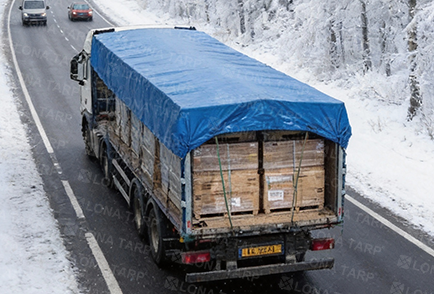
Cold-resistant tarpaulin is perfect for cold-chain logistics, northern storage, cold-region shipping, and outdoor tents because it is less prone to cracking, tearing, or delaminating than regular PVC tarpaulin.
Tarpaulin’s ability to withstand cold temperatures is dependent not only on the composition of the material but also on manufacturing techniques including constant mixing, accurate coating thickness, and low-temperature curing that guarantee reliable low-temperature performance.
I. Failure Mechanisms of Ordinary PVC Tarpaulins at Low Temperatures
Molecular-Level Failure
Plasticizers that lubricate PVC chains are what give regular PVC its flexibility at room temperature. This lubrication decreases at low temperatures:
Plasticizer Migration and Solidification
Certain plasticizers become less mobile or may partially harden, which causes crystallization or surface whitening. Long-term exposure might result in surface peeling and fissures, and flexibility diminishes.
Freezing of Polymer Chain Segments
PVC chains become immobile, and the substance changes from a “leathery state” to a “glassy state,” which lowers its mechanical strength and increases its brittleness.
Systemic Structural Failure
Low temperatures accelerate structural failures:
Stress Concentration Points Crack First
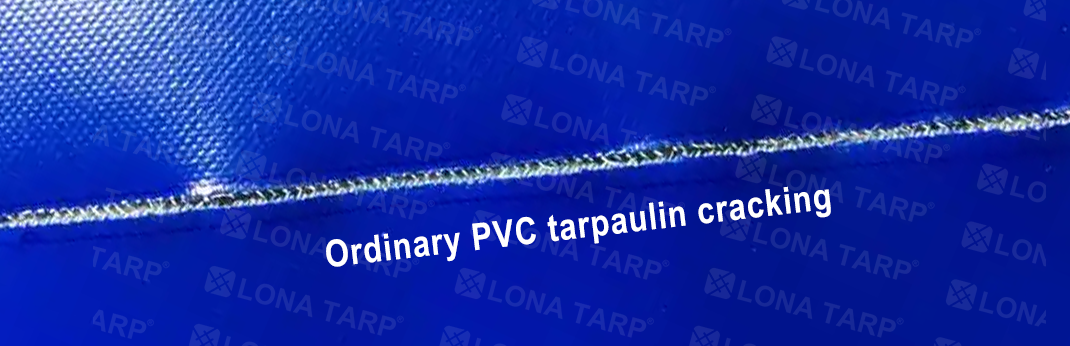
Stress concentration points include stitching lines, welded edges, and grommet surroundings. Low-temperature shrinkage and embrittlement cause cracks to start here first, potentially compromising the entire tarpaulin.
Coating and Fabric Delamination
Differential shrinkage between the coating and polyester base fabric causes peeling, compromising waterproofing and structural integrity.
Case Example: Ordinary PVC tarpaulins used in northern winter outdoor storage often develop seam cracks and coating delamination after one week at -20℃.
II. Formulation and Modification of Cold-Resistant Tarpaulin
Cold-Resistant Plasticizer Systems
PVC’s brittle temperature is greatly reduced by cold-resistant plasticizers, which have limited migration and retain flexibility at low temperatures.
Plasticizer Type | Characteristics | Low-Temperature Suitability | Typical Applications |
Di-Octyl Sebacate (DOS) | Ultra-cold resistant | ≤ -50℃ | Northern outdoor tarps, cold-chain transport |
Di-Octyl Adipate (DOA) | Excellent low-temp performance | ≤ -40℃ | Warehouse covers, equipment protection |
High-Molecular Polyester | Very low migration, durable | -45℃ ~ -50℃ | High-value cargo transport, mobile tents |
Note: When choosing a plasticizer, low-temperature performance, migration, durability, and environmental compliance must all be balanced. Although inferior plasticizers may feel soft at first, they quickly deteriorate at low temperatures.
PVC Resin and Elastomer Modification
- An “elastic network” is created by combining PVC with EPDM, nitrile rubber (NBR), or chlorinated polyethylene (CPE).
- Elastomers absorb impact and tensile energy at low temperatures due of their exceptionally low glass transition temperatures.
- This guarantees that tarpaulins stay flexible and resistant to cracking at temperatures between -30°C and -50°C, making them appropriate for extremely cold conditions.
Auxiliary Modifications and Process Optimization
- Weather resistance is increased by adding anti-aging chemicals, silane coupling agents, and cold-resistant fillers.
- Low-temperature delamination is avoided by precise coating thickness and homogeneity.
- Long-term stability is ensured by improving molecular chain bonding by low-temperature curing.
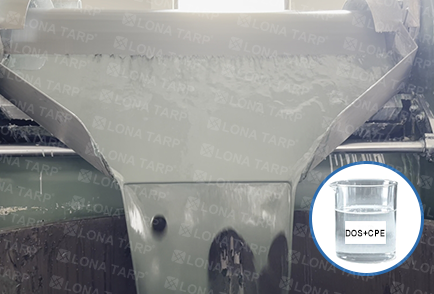
Application Example: DOS + CPE modified tarpaulin, which lasts three times longer than regular PVC tarpaulin, showed no cracking or delamination during winter transportation, according to a northern cold-chain logistics firm.
III. Core Performance Standards and Verification Methods
Low-Temperature Brittleness
Low-temperature brittleness is the key objective indicator distinguishing ordinary PVC from professional cold-resistant PVC.
Brittleness Temperature | Application Scenario | Testing Standard |
≤ -30℃ | Most regions in China | ASTM D746 / GB/T 5470 |
≤ -40℃ | Severe cold regions (Northeast/Northwest China) | ASTM D746 / GB/T 5470 |
≤ -50℃ | Extreme cold regions (Russia, Siberia) | ASTM D746 / GB/T 5470 |
Simple On-Site Verification:
- Samples and regular PVC tarpaulins should be placed in a home freezer at around -18°C for a few hours before being bent.Tarpaulins that are resistant to cold maintain their flexibility, bend readily, and exhibit no fractures or bleaching.
- Products that are inferior may feel soft at first, smell strongly, and lose their low-temperature performance quickly.
- Look for surface cracking or crystallization as early warning signs.
- Advice: For dependable low-temperature performance, always ask for official testing records rather than depending just on provider promises.
IV. Recommended Applications
Northern Winter Outdoor Coverage: During the cold season, equipment and warehouses need to be protected.
High-Value Cargo in Cold Regions: Chemicals and precision equipment cannot be exposed by tarpaulin failure.
Regular Folding and Unfolding: In cold weather, truck tarps and mobile tents must maintain their flexibility.
Extreme Environment Construction & Scientific Equipment Covers: At temperatures between -30°C and -50°C, dependable protection is necessary.
V. Conclusion
Tarpaulin effectiveness in low-temperature settings depends more on the material’s ability to retain flexibility, structural integrity, and waterproof protection under extended cold stress than it does on thickness or weight. At room temperature, regular PVC tarpaulins can seem adequate, but repeated freezing, bending, and mechanical impact reveal their limitations.
Systematic material design that combines low-temperature plasticizers, elastomer modification, and efficient production processes results in a PVC tarpaulin that is genuinely resistant to cold. Cold-resistant tarpaulins greatly lower the danger of cracking, delamination, and premature failure when correctly constructed and validated by standardized testing, eventually safeguarding cargo, equipment, and operational continuity in challenging climates.
Choosing a proven cold-resistant tarpaulin is a long-term investment in dependability, safety, and service life rather than a cost increase for applications involving cold-chain logistics, winter outdoor covering, or transportation in extremely cold climates.

Share Thisw Story:
Table of Contents
Lynn Chen
I’m Lynn from Haining Lona Coated Material Co. For years, I’ve been helping customers find the right PVC coated fabric and related products for their projects. Whether it’s for inflatables, tents, or industrial covers, I’m here to share ideas, answer questions, and make sure you get the right solution. Feel free to reach out — I’m always happy to talk.
Try LonaTarp® Customize Your Tarpaulin Now
- PVC Formulation Properties
- Strength, Weight and Thickness
- Glossy, Matte, Color, Print and 3D Embossed Patterns
- Tarpaulin Roll Sizes and Packaging
- Cutting, Heat Sealing, Sewing, Add Eyelets, and Accessories Purchasing