

What is Tear-Resistant Tarpaulin?
In the world of industrial fabrics, Tear-resistant PVC tarpaulin refers to a specialized composite material designed to resist the propagation of damage when subjected to localized stress—such as snagging, puncturing, or edge tearing. Unlike standard covers, these fabrics are engineered to ensure that a small accidental nick doesn’t turn into a catastrophic failure.
I. Mechanical Definitions: Tensile Strength vs. Tear Strength
It is a common misconception to use these terms interchangeably. However, in textile engineering, they represent two distinct physical properties:
Tensile Strength:
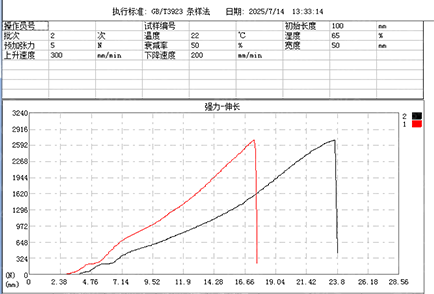
Tensile strength describes a material’s ability to resist force when it is pulled uniformly in one direction until rupture.
- Measured under evenly distributed load
- Reflects the overall strength of the fabric
- Strongly influenced by yarn strength and fabric density
- A tarpaulin with high tensile strength can carry heavy loads, but this alone does not guarantee resistance to tearing once damage has started.
Tear Strength:
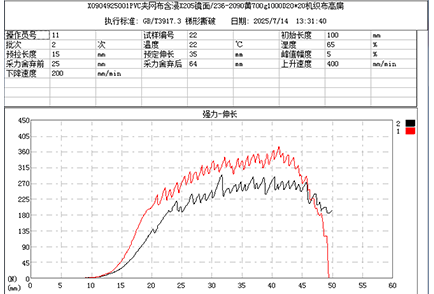
Tear strength measures a fabric’s ability to resist the growth of an existing crack or cut.
- Measured under localized, concentrated stress
- Reflects how cracks propagate through the fabric
- Closely related to yarn mobility, coating adhesion, and structural energy absorption
- In real usage, tarpaulins rarely fail due to uniform pulling. Most failures originate from small cuts, punctures, or edge damage, making tear resistance far more critical than tensile strength alone.
II. How Is It ResistedWhen Tearing Occur?
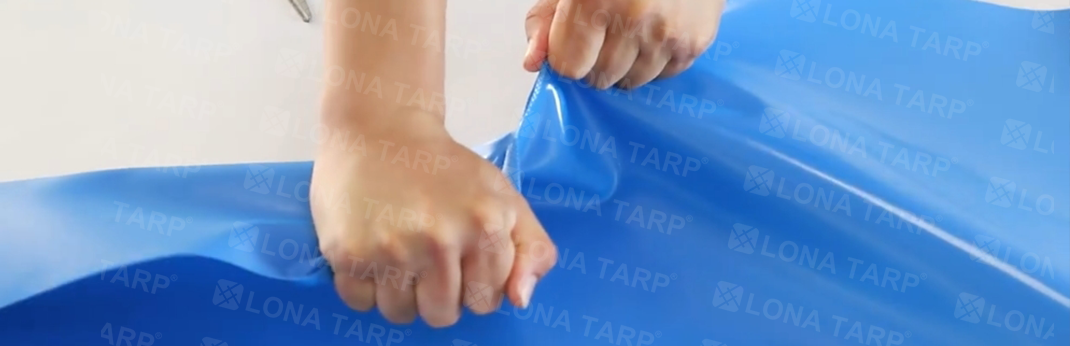
When a PVC tarpaulin is hooked or punctured by a sharp object, an initial micro-tear forms. Under continuous load, this crack begins to propagate.Importantly, this process does not involve the fabric being “stretched thin and ripped apart.” Instead:Stress concentrates at the crack tip.Warp and weft yarns at the crack front are sequentially:Pulled out from the PVC coating, and then broken one by one.
- Low Tear-Resistance Materials: Exhibit “brittle failure.” Once a single yarn snaps, the stress transfers instantly to the next, leading to a rapid, unstoppable broken (the “zipper effect”).
- High Tear-Resistance Materials: These are designed to dissipate and absorb the stress at the crack tip, forcing the crack to consume significantly more energy to expand.
Three Core Material and Structural Factors Behind High Tear Resistance Materials.
High-Strength, High-Toughness Base Fabric
- Yarn Selection – High-tenacity polyester filament yarns,Optimized elongation at break (typically 12–20%)
- Weaving Structure – High warp and weft density,More yarns per unit area.
-Plain weave as the primary structure
Coating–Fabric Composite Engineering
The PVC coating does more than provide waterproofing; it acts as a matrix that binds the individual yarns into a unified load-bearing structure.
Impregnation (Dip-Coating) Process
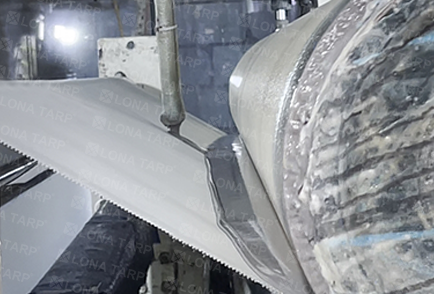
In high-performance materials, PVC plastisol must fully penetrate the interstices of the woven fabric:
- Each yarn is individually encapsulated
- Frictional holding force between coating and yarn is maximized
- Yarn pull-out during tearing becomes significantly more difficult
As a result, tearing requires overcoming both yarn strength and coating grip resistance.
Adhesion Between Coating and Fabric
Strong interfacial adhesion ensures that:
- Failure occurs within the composite structure, not at the interface
- Delamination is avoided during tearing
- Mechanical energy is dissipated through the entire material system
Poor adhesion leads to premature coating separation, which dramatically reduces tear resistance regardless of yarn strength.
- Reinforcement Design and Edge Protection
Tears often originate at edges, corners, and connection points. Structural reinforcement is therefore essential.
Box Welding and Reinforcement Strips
- Double-layer or multi-layer constructions at high-stress zones
- Reinforcement patches distribute load over a larger area
- Commonly used at corners, eyelet zones, and central tension points
Edge Sealing and Binding
- High-frequency welding or thickened coating at edges
- Prevents yarn exposure and edge fraying
- Reduces the risk of progressive “yarn extraction” during service
Proper edge treatment often determines whether a tarpaulin lasts months or years in real use.
III. Key Performance Standards for Tear-Resistant PVC Tarpaulins
Tear Strength Testing
Standard: DIN 53363:2003 — Testing of coated fabrics; determination of tear resistance
Test Principle
This standard is specifically designed for PVC-coated and polymer-coated fabrics, making it highly relevant for industrial tarpaulin evaluation.
- A pre-cut slit is introduced into the specimen
- The fabric is subjected to tensile force perpendicular to the tear direction
- The force required to propagate the existing tear is continuously measured

Unlike simple tensile tests, DIN 53363 focuses on controlled crack propagation, closely replicating real tearing behavior encountered during service life.
Data Interpretation
- Tear resistance is expressed in Newtons (N)
- Higher values indicate stronger resistance to tear propagation
- Test results should be provided for both warp and weft directions, as tear behavior can differ significantly depending on fabric orientation
Balanced tear resistance in both directions indicates a well-designed fabric structure with uniform stress distribution.
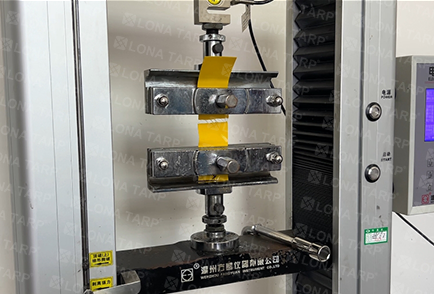
Tensile Strength Testing
Standard: DIN 53354:1981 — Testing of coated fabrics; determination of tensile strength and elongation at break
Test Principle
This test measures the fabric’s ability to withstand uniform tensile loading until rupture.
- Specimens are clamped and pulled at a controlled speed
- Maximum tensile force and elongation at break are recorded
- Both warp and weft directions are tested
DIN 53354 is widely recognized in Europe as a core mechanical standard for PVC tarpaulins and coated industrial textiles.
Data Interpretation
- Breaking force (N): Indicates overall load-bearing capacity
- Elongation at break (%): Reflects material toughness and energy absorption capability
A high-quality tear-resistant PVC tarpaulin should demonstrate high tensile strength combined with moderate elongation, ensuring both structural strength and resistance to sudden, brittle failure.
Understanding these principles allows buyers and engineers to evaluate tarpaulins beyond surface specifications and select materials that deliver long-term durability and real-world reliability.
Share Thisw Story:
Table of Contents

Ted Luo
I am Ted. I have been working in the PVC tarpaulin industry at Haining Lona Coated Material Co., Ltd. for nearly 10 years.With nearly 20 years of experience in the textile foreign trade industry. I am confident that my professional expertise and high-quality products will win your trust.
Try LonaTarp® Customize Your Tarpaulin Now
- PVC Formulation Properties
- Strength, Weight and Thickness
- Glossy, Matte, Color, Print and 3D Embossed Patterns
- Tarpaulin Roll Sizes and Packaging
- Cutting, Heat Sealing, Sewing, Add Eyelets, and Accessories Purchasing
