

Why is the Minimum Order Quantity for PVC Tarpaulin Production So High?
PVC tarpaulin’s superior waterproofing, durability, and tear resistance make it a popular choice in the sphere of industrial material procurement. There is a consistent need for this material, whether for outdoor events, logistics and shipping, or large-scale storage. However, the comparatively large Minimum Order Quantity (MOQ) during first inquiries sometimes baffles a lot of consumers.
In actuality, PVC tarpaulin’s high minimum order quantity (MOQ) is mostly dictated by its status as an industrially mass-produced product, its intricate cost structure, and the objective needs of scaled manufacturing rather than being an arbitrary threshold established by producers. Buyers may create more intelligent procurement strategies to attain maximum cost-effectiveness by comprehending the underlying industrial logic.
I. PVC Tarpaulin is Essentially an Industrial Continuous Production Product
PVC tarpaulin’s large Minimum Order Quantity (MOQ) is a direct result of its basic nature as an industrial continuous manufacturing product rather than a question of manufacturer desire. This implies that rather than on-demand, piecemeal fabrication, its manufacture is characterized by large-scale, capital-intensive machinery and procedures intended for efficiency and quality at enormous numbers.
1-1. The Imperative of Large-Scale, Continuous Processing

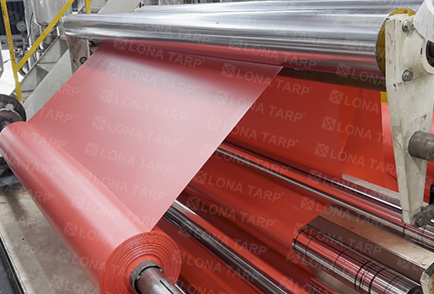
The coating line, a multi-station monster that is frequently more than 50 meters long, is at the center of manufacturing. Base fabric unwinding, precision coating, high-temperature gelation, controlled chilling, and final rewinding are all completed in a single continuous flow by this integrated system. It is extremely inefficient to start and calibrate this complicated equipment for a tiny batch. More importantly, pausing and resuming throws off the chemical and thermal balance, resulting in uneven adhesion, coating thickness, and overall performance. Therefore, sustaining a lengthy, continuous production run—which inevitably generates a sizable base production volume—is inextricably related to establishing consistent product quality and homogenous physical attributes.
1-2. Upstream Supply Chain Realities Dictate Scale
Before the coating line ever begins, scale is required. Large-scale industrial weaving produces the high-strength polyester fabric, such as 500D or 1000D material, which is the fundamental framework of the tarpaulin. Selling base fabric by the kilometer and polyester yarn by the ton, raw material providers have their own strict minimum order quantities. These upstream economic units have an impact on our procurement as a manufacturer. The supply chain is built on bulk transactions, which establishes a fundamental minimum for each production order, thus we cannot order 100 meters of base fabric any more than a bakery can purchase a single grain of flour.
1-3. The “Roll” as the Indivisible Unit of Production
In a craft sense, PVC tarpaulin is made and sold by the roll rather than the meter. Master rolls that are hundreds or thousands of meters long are covered with standard widths (such as 2, 3, and 5 meters). To avoid defects like creases, uneven coating, or delamination, the coating procedure necessitates applying heat and tension in exactly the same way throughout the fabric’s width and length. It is theoretically impossible and would jeopardize the integrity of the whole batch to arbitrarily cut and splice tiny pieces during a production run. As a result, the entire “roll” is the smallest, logical, and quality-assured unit of output, allowing for modest, custom-length orders to be placed outside of the typical manufacturing logic.
In essence, the MOQ reflects the minimum efficient scale required to activate the industrial production system and deliver a product that meets consistent performance standards. It is the economic and technical signature of a true industrial material.
II. The Truth Behind the Costs of Minimum Order Quantity
In PVC tarpaulin manufacturing, the Minimum Order Quantity (MOQ) is the threshold necessary for production to be economically feasible and is a direct reflection of the underlying cost structure. It is the point at which the substantial fixed expenses involved in the industrial production process may be absorbed and fairly distributed by the total order value, keeping the cost per unit from becoming unaffordable.
2-1. The Economics of Single-Run Start-up Costs
There are significant, non-negotiable fixed expenses associated with every manufacturing start that are completely unrelated to the volume of ultimate output. These include the substantial energy expenditure needed to raise multi-zone ovens to a steady, accurate operating temperature (often higher than 200°C), the technical labor and machine time needed to calibrate the gravure rollers and coating head for consistent application, and the exact PVC plastisol compound preparation. These expenses are essentially “sunk” prior to the coating of the first meter of cloth. By distributing these fixed “set-up costs” over a tiny order volume, the project becomes unfeasible due to the high cost per meter. Therefore, in order to reach a commercially reasonable unit pricing and amortize these front-loaded costs, a higher MOQ is required.
2-2. The Scale Imperative of Raw Materials and Custom Formulations
Scale is also required by formulation economics and procurement. Chemical vendors usually provide high-performance additives in large amounts, such whole barrels or totes, that offer UV resistance, anti-fungal qualities, or flame retardancy (e.g., to satisfy B1 standard). Opening a specialized, expensive addition for a tiny batch for a specific demand results in waste, shelf-life expiry, and poor capital allocation, which significantly raises material prices. In a same vein, developing a distinctive hue necessitates commissioning a bespoke masterbatch in a minimum manufacturing number that frequently much exceeds the requirements of a restricted order, resulting in inevitable surplus and expense.
2-3. The Capital Investment in Tooling and Molds
Personalized physical characteristics cost a substantial amount of money. Custom tooling, such as embossing rollers or laminating heads, must be designed and machined for features like a particular diamond embossed pattern for anti-slip qualities, a unique weave texture, or a composite lamination structure. Such tools can be expensive to develop and fabricate. This “mold cost” or “plate fee” is a one-time capital expenditure that needs to be paid back in full throughout the course of that particular product variant’s whole manufacturing volume. This tooling expenditure is monetarily unattainable because to a tiny MOQ. As a result, the tooling cost and the necessary payback period are inextricably connected to the MOQ.
III. How Can Buyers Overcome the Challenge of High Minimum Order Quantity?

While high MOQ is a structural reality of industrial manufacturing, it is not an insurmountable barrier. Strategic buyers can effectively navigate this requirement by aligning their procurement approach with the economics of production. Instead of viewing MOQ as a limitation, it can be approached as a variable to be managed through smart planning and collaboration.
3-1. Strategic Solution: Opt for Standard Stock Specifications
The most direct and cost-effective method to bypass high custom MOQ is to select from a manufacturer’s standard stock items. Leading producers actively maintain inventory of the most in-demand specifications, which represent high-volume, pre-scheduled production runs.
For instance, we consistently stock high-turnover items such as:
- 680gsm & 750gsm PVC Tarpaulin in standard white and blue.
- Standard Truck Side Curtain Fabric with common weaves (e.g., 20×20).
- Base-level waterproof and UV-resistant fabrics for general-purpose use.
By choosing these readily available options, you are essentially tapping into an existing economies-of-scale pipeline. This allows you to benefit from bulk pricing and availability while often reducing the effective MOQ to a practical range of 500 to 1,500 meters, with lead times shortened to days or weeks instead of months. You can browse our current stock on our official website or Alibaba store.
3-2. Collaborative Solution: Pursue Consolidated or Group Purchasing
When your project necessitates custom features—such as a brand-specific color (PMS matching), a certified flame-retardant treatment, or a unique width—consolidation is the key strategy. This involves combining demand to meet the factory’s minimum efficient scale.
Effective consolidation typically operates through three models:
- The Distributor/Aggregator Model: If you are a reseller, you can consolidate orders from your own diverse client base into a single, larger manufacturing order that meets the factory’s MOQ.
- The Industry Consortium Model: Companies within the same sector (e.g., several event rental companies) can form a buying group to jointly commission a production run of a specially designed fabric, sharing the development costs and MOQ burden.
- The Production Window Model: Proactive communication with your manufacturer is crucial. By expressing your needs and timeline flexibility, you allow them to schedule your custom order alongside another client’s compatible request in the same production slot. This “shared run” is a common industry practice that can dramatically lower your entry threshold for customization.
In summary, overcoming the MOQ challenge hinges on a buyer’s flexibility—either in product specification by choosing standard options, or in procurement method by leveraging collaboration. A transparent dialogue with your manufacturer about these strategies is the first step toward a feasible and cost-effective solution.
IV. Conclusion
In conclusion, the large Minimum Order Quantity for PVC tarpaulin manufacture is a necessary consequence of guaranteeing product quality consistency and production economy, as well as an outward reflection of its intrinsic qualities as a contemporary industrial product. It is an objective representation of industry dynamics rather than a trade barrier.
The answer for purchasers is to dynamically modify their procurement strategy, using basic stock for everyday needs and using planning or cooperative purchasing to address specific demands. As a manufacturer with more than ten years of experience in the industry, we are dedicated to assisting clients of all kinds in finding the best solutions through open communication and adaptable options (such as small-batch consolidation services), in addition to offering a complete range of premium PVC tarpaulins from 280gsm to 1500gsm. You are welcome to consult us through our official channels anytime for detailed technical parameters and the latest product information.
Share Thisw Story:
Table of Contents

Neena Zhou
Hello, I’m Neena, specializing in the PVC tarpaulin industry for over five years. Backed by our factory’s 20+ years of expertise and advanced coating technology production line , I am confident that our high-quality products and professional services will earn your trust. Feel free to contact us!