

 When a fierce gale rips the tarpaulin off a truck in transit, exposing hundreds of thousands worth of goods to a downpour in an instant…
When the roof of a temporary warehouse collapses under the weight of accumulated snow, crushing production equipment…
When a batch of meticulously processed products arrives damaged beyond recognition due to abrasion during transport, followed by a wave of customer claims…
These heartbreaking scenarios often stem from a seemingly minor decision error – choosing the wrong PVC tarpaulin thickness.
For manufacturing processors, trading distributors, and engineering service providers, PVC waterproof tarpaulin is not just material; it’s a critical barrier for cost control, brand reputation, and project success.
I. Why PVC Waterproof Tarpaulin Thickness is the Invisible Guardian of Your Business Success?
1. PVC Thickness Helps Control Product Costs
 Using the right PVC waterproof tarp thickness accurately helps businesses save costs. Conversely, PVC that is too thin or too thick increases costs.
- Too Thin: Frequent replacements, high cargo damage compensation, loss of customer trust. A single major loss can wipe out months of profits.
- Too Thick: Unnecessary surge in material costs, increased processing difficulty, reduced product competitiveness.
2. Correct PVC Thickness Provides a Risk Firewall
PVC waterproof tarpaulins with precisely matched thickness mean longer service life, lower overall maintenance costs, stronger customer satisfaction, ultimately translating into your solid market position and substantial profit margins.
Using the wrong PVC waterproof tarpaulin thickness, however, significantly increases product risks for different businesses:
- Manufacturing Processors: Inaccurate thickness leads to product defects, downstream customer complaints, strained supply chain relationships, and even massive claims.
- Trading Distributors: Underperforming stock tarps become stagnant, tying up capital; constant after-sales disputes erode brand reputation.
- Engineering Service Providers: Tarp failure on-site triggers safety incidents, project delays, failed acceptance, severely damaging company reputation.
II.Decoding Core Application Scenarios: What PVC Tarpaulin Canvas Thickness Does Your Customer Need?
Scenario 1: Logistics & Transportation / Truck Tarps – Mobile Asset Fortresses
a. Core Threats:
High-speed wind tearing, frequent loading/unloading friction, UV degradation, extreme temperature changes, rainwater penetration.
b. Thickness Selection Guide (Key Considerations):
 Cargo Value & Risk: High-value, fragile goods (e.g., precision instruments, furniture, luxury items) demand high-strength PVC tarp canvas of 0.80mm or thicker. Standard goods can consider 0.45mm – 0.65mm.
Transport Distance & Environment: Long-haul, cross-climate zone transport faces greater challenges; increase thickness by at least 1.00mm. Special reinforcement needed for rainy, high-wind, high-UV areas.
Vehicle Type & Covering Method: Flatbeds, high-side trailers experience high side wind loads; recommend 0.60mm+. Partial covering on box trucks can use around 0.50mm. Areas subject to frequent mechanical handling require extra wear-resistant layers.
You can choose the PVC tarpaulin products you want here.
c. Real Cost of Choosing Too Thin:
A mid-sized logistics company opted for standard 0.40mm PVC tarpaulin canvas on a long-haul precision equipment shipment to save costs. Encountering strong winds en route caused multiple tears, leading to rain damage. A single claim exceeded RMB 800,000 – far exceeding the “savings” from the tarps.
d. Start Your Consultation Now:
- Is the value per item you transport over RMB 10,000?
- Does your route frequently pass coastal or mountainous areas?
- Contact us to secure every shipment.

Scenario 2: Warehousing Covers & Temporary Structures – Static Economic Barriers
a. Core Threats:
Snow/water accumulation pressure, long-term UV exposure, wind load tearing, mold growth, fire resistance requirements.
b. Thickness Selection Guide (Key Considerations):
 Span & Structure: Large spans (>6m) or low-slope roofs face drastically increased snow/water pressure; must use 0.80mm – 1.20mm or even reinforced extra-thick waterproof PVC tarpaulins. Small stockpile covers can use 0.55mm – 0.70mm.
Climate Loads: High-snow areas (e.g., Northern China), high-wind areas (e.g., coastlines, wind tunnels) are critical protection zones; thickness needs 0.15mm – 0.30mm increase plus reinforcement rib design.
Usage Duration: Long-term fixed structures (>1 year) demand extremely high anti-aging properties; minimum 0.75mm+ with premium UV coating. Short-term seasonal covers can be slightly lower (around 0.60mm).
Special Requirements: Locations requiring specific fire ratings (e.g., B1 class) – while thickness isn’t the sole factor – typically need denser base fabric (0.70mm+) to ensure effective flame retardant loading and overall strength.
c. Real Cost of Choosing Too Thin:
A northern building materials market used 0.65mm waterproof PVC tarpaulins for a temporary warehouse roof. After a heavy snowfall, the roof collapsed extensively, destroying inventory. Cleanup and rebuilding costs exceeded RMB 500,000, not to mention the incalculable loss from peak season disruption.
d. Start Your Consultation Now:
- What is your warehouse span?
- What was the maximum snow depth in your location in the last 10 years?
- Contact us, send relevant parameters, get a precise recommendation in 5 minutes!
Scenario 3: Equipment Packaging & Outdoor Protection – Personal Guards for Precision Assets
a. Core Threats:
Sharp edge punctures, transport vibration abrasion, condensation erosion, dust ingress, custom fit requirements.
b. Thickness Selection Guide (Key Considerations):
 Equipment Characteristics: Heavy machinery, equipment with sharp protrusions or edges are high puncture/abrasion risks; contact areas must use 0.70mm – 1.00mm or locally applied wear-resistant china PVC coated tarpaulins. Precision instruments require dust/moisture protection; 0.50mm – 0.65mm high-quality, dense tarp fabric is key.
Protection Level: Long-term outdoor storage (e.g., construction machinery) requires resistance to combined aging; recommend 0.75mm+. Moisture/abrasion protection inside shipping containers often suffices with around 0.60mm PVC tarpaulin canvas.
Processing Compatibility: Manufacturers requiring frequent welding, eyelet punching, or sewing must consider thickness compatibility with processes. Excessive thickness (>1.0mm) can increase processing difficulty and defect rates.
c. Real Cost of Choosing Too Thin:
A batch of exported precision machine tools was packaged using generic 0.55 mm PVC tarpaulins. During sea transit, equipment edges wore through the tarp, allowing humid air to cause critical component rust. The shipment was rejected upon arrival, resulting in over RMB 1 million in return and refurbishment costs.
d. Start Your Consultation Now:
- Does your equipment have exposed edges/corners?
- What is the expected sea shipping duration?
- Provide equipment photos/drawings. Our packaging engineers will create a FREE Customized PVC Waterproof Tarpaulin Protection Level & Thickness Matching Plan for you, ensuring absolute safety.
III. Beyond the PVC Thickness Number: Key Supporting Elements for Guaranteed Performance
Thickness is the foundation, but not a panacea. These elements are equally crucial for building a reliable defense line:
1. Base Fabric Material & Weave Density:
- High-Tenacity Polyester Yarns: The foundation for tensile and tear strength. Higher yarn denier (e.g., 1000D, 1500D) means greater single-yarn strength.
- Dense Weave Structure: Such as 9×9, 9×12 threads per inch, significantly enhances puncture resistance and dimensional stability. Dense base fabric + moderate thickness often outperforms loose base fabric + high thickness.
- Our Advantage: We use branded high-denier low-shrinkage yarns with proprietary weaving technology, boosting tear strength by 20% at the same thickness. Request FREE base fabric samples for your own comparison!

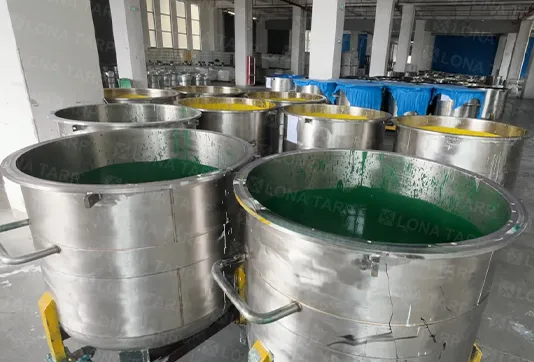
2. Coating Process & Formula:
- Premium PVC Resin + Plasticizer System: Determines flexibility, low-temperature performance, migration resistance. Eco-friendly plasticizers (e.g., DINCH) are essential for high-end applications.
- Coating Uniformity & Adhesion: Affects waterproofing, abrasion resistance, and lifespan. Knife-coating process control is key.
- Functional Additives: UV inhibitors (anti-aging), flame retardants, anti-fungal agents, etc., require sufficient, stable addition and synergistic action with thickness.
- Contact Us: Worried increased thickness makes tarps stiff? Our exclusive flexible formula ensures 0.80mm remains pliable and easy to process! Describe your application environment for a FREE Custom Coating Formula Recommendation Report.
3. Reinforcement Design & Craftsmanship:
- Reinforcement Ribs (Strips): In large-span, wind-load scenarios (e.g., building roofs), scientifically placed ribs are more cost-effective than simply increasing overall thickness.
- Corner/Edge Reinforcement: Extra patches, binding, or heat-sealing at high-stress points (e.g., attachment points, seams) significantly extends lifespan.
- High-Precision Welding/Sewing: Seam strength determines overall reliability. Advanced hot-air welding, high-frequency welding, or high-strength thread sewing is crucial.
- Contact Us: Limited budget for a large-span project? Our reinforcement rib design achieves the strength of 1.0mm using 0.75mm, saving 20% on material costs! Contact now for a FREE Structural Optimization Plan.

IV. Precise Decision-Making: Obtain Your Optimal Heavy Duty PVC Tarpaulin Thickness Solution
Avoid blind choices; a scientific process is key:
1. Deep Needs Diagnosis:
 Define core application scenario & specific use (e.g., Trucking precision instruments, 15m span temporary warehouse in Northeast China).
- Identify primary threat sources (Strong wind? Snow load? Friction? Chemicals?).
- Quantify key metrics: Expected service life? Minimum tensile/tear strength required? Environmental/fire standards? Budget range?
- Technical Support: Contact us anytime. Provide relevant details (use our detailed scenario/threat/metrics checklist) for a FREE Preliminary Thickness Range Report!
 Define core application scenario & specific use (e.g., Trucking precision instruments, 15m span temporary warehouse in Northeast China).
2. Sample Physical Validation:
- Thickness Test: Use a professional thickness gauge for multi-point measurement ensuring uniformity.
- Performance Test Swatches: Request actual heavy duty PVC tarpaulin samples for simple yet critical tests:
- Feel & Flexibility: Assess brittleness at low temperatures.
- Tear Resistance: Try manual tearing (safely) to gauge resistance.
- Abrasion Resistance: Rub with rough object, observe surface changes.
- Waterproofness: Drip water, observe absorption.
- Special Support: Skeptical of data? Request a FREE A/B Sample Kit (different thicknesses/processes) to experience the difference firsthand!
3. Supplier Capability Assessment:
- Technical Consultation Expertise: Does the supplier ask detailed questions and provide data-backed recommendations?
- Customization Capability: Can they adjust thickness, coating formula, reinforcement design per your needs?
- Quality Certifications & Test Reports: Request authoritative third-party test reports (Tensile, Tear, UV Resistance, Flame Retardancy, etc.).
- Production Consistency Assurance: Understand how they control batch-to-batch thickness and performance stability.
